


Therefore shall they now go captive with the first that go captive; and the revelry of them that stretched themselves shall pass away.
The Lord Jehovah hath sworn by himself, saith Jehovah, the God of hosts; I abhor the excellency of Jacob, and hate his palaces; therefore will I deliver up the city with all that is therein.
And it shall come to pass, if there remain ten men in one house, that they shall die.
And when a man’s uncle shall take him up, even he that burteth him, to bring out the bones out of the house, and shall say unto him that is in the innermost parts of the house, I there yet any with thee? and he shall say, No; then shall he say, Hold they peace; for we may not make mention of the name of Jehovah.
For, behold, Jehovah commandeth, and the great house shall be smitten with breaches, and little house with clefts.
Shall horses run upon the rocks? will one plow there with oxen? that ye have turned justice into gall, and the fruit of righteousness into wormwood; ye rejoice in a thing of nought, that say, Have we not taken to us horns by our own strength?
For, behold, I will raise up against you a nation, O house of Israel, saith Jehovah, the God of hosts; and they shall afflict you from the entrance of Hamath unto the brook of the Arabah.
Amos 6:7–14
The second main division of the book of Amos, from 3:1 to 6:14, contains the various prophecies which the prophet has spoken to the people of his day. They have been messages of woe for their sins. The sins of Israel were vividly portrayed. The people must first know how great their sins and miseries are. The people have prided themselves on their wealth. They give an outward impression of real piety. They have expressed their longing for the great day of Jehovah to come.
What is it going to be like when that great day does come? Amos had already warned them that it would be a day of darkness and not light (5:18). Now that day will be described more fully.
The individuals to whom he has addressed himself specifically at the beginning of this chapter are the notable men. These were the “first” among the “first” people. How will they be “first”? They will be the first to go captive! These people who lay sprawled on their couches doing wickedness will be taken out of their own land. God will remove the revelry by removing those who practise it. Jehovah has been patient with this nation, but the measure of iniquity is full to overflowing. He abhors the pride of Israel. Their pride has blinded their eyes to their own sin. He now hates Israel’s palaces. No longer does Jehovah delight in his people. He has sworn by himself to deliver up the whole city (Samaria) and all it contains. There is no possibility of reprieve. When God swears by himself it is certain. When men bolster their words with an oath, the truth of something extremely important is established.
When God swears by himself, absolute certainty is established. He swears that Israel will go into captivity.
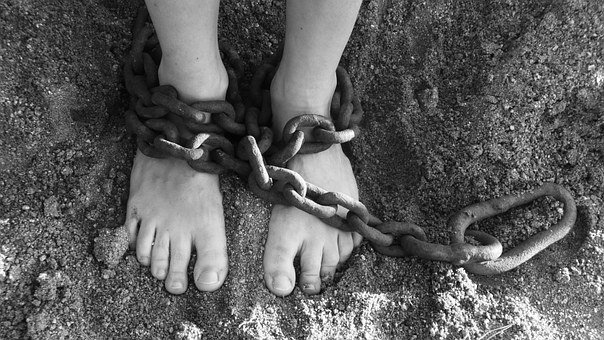
To give as clear a picture as possible of that day which is coming, the prophet now gives an illustration of what will happen. In this illustration the people will have a picture of that day of Jehovah. The prophet does not speak concerning the darkness of that day in general terms only. He is very specific. This is the picture; Even though there may be ten persons inone house, in one family. they will all die. Not only will the sword of the enemy slay, but pestilence will also claim its victims. When death has come to the inhabitants of this house, a relative will come with one who will take the bodies for cremation. Cremation is evil (2:1) but the times are such as to make this method of disposing of dead bodies necessary. While the bodies are being removed, the relative hears someone in a back room of the house. Here is one who is sick and still living. The relative calls to him and asks if there are any others with him. The answer is: No. He then cautions the sick man not to say any more. There is a danger that he will speak the name of Jehovah in these circumstances. The Israelites spoke that name so readily. Especially now, in tills time of unspeakable grief, there is the danger that Jehovah’s name will be spoken. Danger? Would this not be natural? Would it also not be desirable to hear the name of the God of life here in the midst of death?
Here Amos shows the thinking of the people of Israel. It was similar to the thinking of the heathen. The heathen believed, and Israel now shares that view, that if the name of a deity were mentioned, his attention would be attracted! Don’t mention the name of Jehovah! He is the One who has caused this evil to come. If you now mention his name, you will attract his attention, and you and I who are still living will also perish. They have become afraid of Jehovah! This is not a godly fear, but a fear born of heathen superstition. Amos illustrates the conditions of that day and their religious thinking.
The people have not been mistaken in the view that it is indeed Jehovah who has brought this evil upon them. He commands the evil to come. He has jurisdiction over all powers. Both the great house and the little house shall be smitten. Amos is not a revolutionary who hurls his woes only against the rich. The sins of Israel are found among all classes. The rich may have greater opportunities to sin but the poor are no better.
Do horses run upon the rocks? Do unshod horses run on sharp stones? Of course not. Will one plow with oxen? The answer is: Yes. We see, therefore, that this is a meaningless translation. The prophet expects the same answer in both instances. The translation favored by the best scholars is: Will one plow the sea with oxen? Then the answer must be: No. Amos here speaks of impossible things. No horse would run on jagged rocks. No one would ever think of plowing the sea with oxen. Natural laws are readily understood by men. But Israel has turned justice into poison and the result of righteousness into something hitter. This practice of Israel in the moral realm is no more logical than horses running on rocks or plowing the sea with oxen in the physical realm.
Verse 13 is also very difficult to understand in our translation. Two names are mentioned in the original which we do well to leave untranslated. These are names of places, Lodebar (II Sam. 9:4) and Karnaim (Gen. 14:5). Neither one of these places was very important. Israel had conquered both these cities. They prided themselves on the victories obtained. These exploits made them feel secure.
God will bring up a nation against them. That nation will really test their strength. Again, the prophet does not mention this nation by name, but it is very evident that he means Assyria. Israel may have defeated Lodebar and Karnaim but will be no match for Assyria. This nation will afflict Israel. It will press them. No land will be big enough to hold both Assyria and Israel. When this nation comes against Israel it will afflict the people from the one extreme border to the other. The destruction will be total. Surely, when that day comes it will not be a day of light but a day of thick darkness. Only a people reconciled to their God will be able to look forward to that day.
Questions for discussion:
1. Why does God swear by himself at times? Is this always an indication of something momentous?
2. When does God hate the palaces of a people?
3. Cremation was forbidden in Israel. Are there ever times when that which is forbidden may be done? Do circumstances determine right and wrong?
4. Did the Israelites mention the name “Jehovah” in later times?
5. Can the arguments which Amos uses in the first six chapters be used against capitalism as a system? Is capitalism Scriptural?
6. Is there a danger that we, as a church, pride ourselves on the accomplishments of former days and become blind to present dangers?