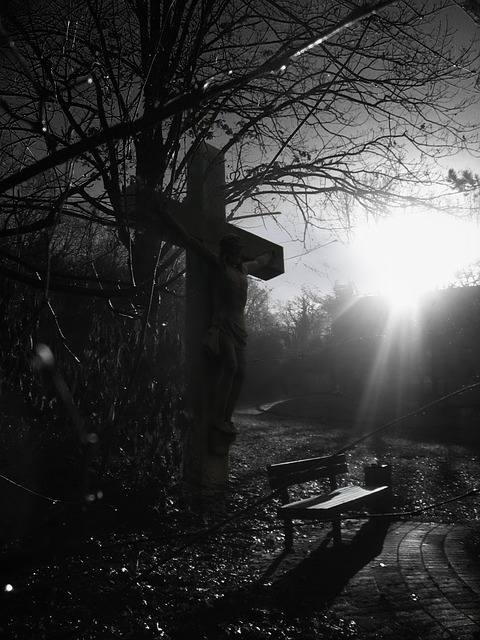
“He has given us new birth into a living hope through the resurrection of Jesus Christ from the dead” (I Peter 1:3, NIV).
A Musical Confession
The B Minor Mass of Johann Sebastian Bach has been acclaimed the greatest work of possibly the world‘s greatest musician. Although he called his work a ” mass” and used the words preserved through the centuries in the liturgy of the Roman Church, Bach, a Protestant, an earnest, orthodox Lutheran, was not giving any support to Roman misinterpretations of the Lord’s Supper, but making a remarkable confession of gospel faith. His music reverberates with the grand affirmations of t he gospel. Nowhere do they come to more thrilling expression when he deals with the Lord’s resurrection in relation to that of His people. A large part of this work, no less than eight movements, is an exposition of the Nicene Creed (one of our church creeds which we might profitably use much more than we usually do). As the music seeks faithfully to reflect the gospel events which we confess, it becomes slow and somber when it recalls Christ “crucified also for us under Pontius Pilate, He suffered and was buried.” Then, in the sharpest possible contrast, Easter day dawns with “Et resurrexit,” “He arose the third day according to the Scriptures,” a vivacious and exhilarating chorus in which the choir is virtually turned into an orchestra in a way that must be heard in order to be thought possible. And this excited confession of the Lord’s resurrection is echoed a little later when, in a musical arrangement that unmistakably imitates that confession, the Christian affirms with the same lively enthusiasm, “And I expect the resurrection of the dead, And the life of the world to come, Amen!” The great Christian composer at this point succeeded in conveying in a manner that defies description the biblical message of the resurrection of our Lord.
The Bible’s Revelation
The Easter story in the gospels began in the gloom of a funeral. The Lord’s followers needed to learn the fact of His resurrection, and, what was equally important, the Bible’s explanation of the meaning of it. Notice t he remarkable way in which the Lord Himself twice in the 24th chapter of Luke stressed that point. Even before the two men who talked with him were permitted to recognize Him, their neglect of the Scriptures had to be corrected. “O foolish men, and slow of heart to believe in all that the prophets have spoken!” “And beginning from Moses and from all the prophets, he interpreted to them in all the scriptures the things concerning himself” (vss. 25, 27). A little later in the account the same point was stressed again. To show them that he was really present, he “ate before them. And he said unto them, These are my words which I spake unto you, while I was yet with you, that all things must be fulfilled , which are written in the law of Moses, and the prophets, and the psalms concerning me. Then opened he their mind, that they might understand the scriptures; and he said unto them, Thus it is written, that Christ should suffer, and rise again from the dead the third day; and that repentance and remission of sins should be preached in his name unto all the nations, beginning from Jerusalem. Ye are the witnesses of these things” (vss. 43–48).
A Restored Vision
The church of the Middle Ages had largely lost the clear understanding of the gospel and therefore too the confident personal assurance and hope men ought to have from knowing the Risen Lord. I have often noticed the lack of such assurance expressed, for example, in the somber music of the Roman Catholic requiems or funeral masses. One notices anxious prayers for the dead and appeals to be delivered from the threatening judgment, but no jubilant assurance like that of the Apostle: “I know whom I have believed, and am persuaded that he is able to keep t hat which I have committed unto him against that day.” Faulty Roman doctrines of salvation partly by works, of purgatory and of the impossibility of personal assurance except by special revelations, robbed the medieval church member of such assurance. Men had lost this because they had, like the Lord‘s disciples, become “foolish men . . . slow of heart to believe” all of the Bible.
The biblical understanding of and confidence in the gospel, restored in the Reformation as men were led back to the Scriptures, animated Bach and his glorious music. He confessed and taught us to confess that the Lord, “arose according to the Scriptures” and therefore we too are to expect with the same confident enthusiasm, “the resurrection of the dead, and the life of the world to come.” We constantly need to relearn that lesson as the Apostle Paul (in Eph. 1:15–23) prayed that the church might do. When in our time church leaders replace faith in the Bible as God’s Word with scholarly criticism of it, the clear faith and confident assurance of the gospel disappears from the life of the church and it begins to slide back into the confusion and gloom of the Dark Ages. We need to recover the Bible’s clear teaching and confident confession as the Reformers taught it and as Bach also so impressively taught us to sing it. When the Lord takes from us, sometimes suddenly, believing relatives or friends, as a reminder of the transiency also of our own lives, we are not to be in sorrow as though we had no hope (I Thess. 4:13). We are called to share the faith and confession that as the Lord “arose the third day according to the scriptures” we too “expect the resurrection of the dead and the life of the world to come.”