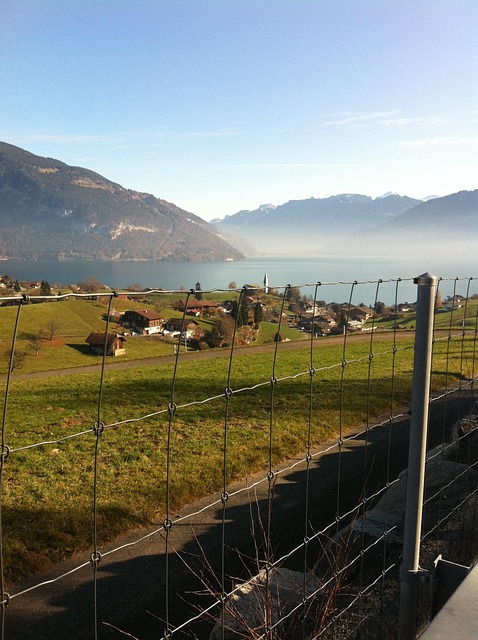
An auto tour across Switzerland had brought us on Saturday to the Interlaken area. After spending the forenoon in the glorious scenery north of the Jungfrau, we headed west across a couple of mountain passes to locate, if possible, the little village of Huemoz, a part of which had been made familiar through the work of Francis Schaeffer as “L’Abri.” Descending the mountain from Villars, we found the village and, on driving through it a second time, located a sign that indicated that we had found our destination. Although a European evangelism conference was concluding, we were guided to accommodations, and thus had opportunity to get a little firsthand acquaintance with this influential work. An evening discussion led by Ellis Potter, a former Buddhist monk, on evangelism to Muslims, gave an impression of both the substantial material of the conference and the variety of mostly young people involved.*
The next morning’s church service was led by one of the featured speakers, Professor Paul Wells, Systematics professor at the Reformed Theological Seminary at Aixen-Provence, France. The message, based on Amos 7:10–17, was a stirring encouragement to faithful gospel testimony in a hostile environment. In the best tradition of Reformed preaching, it revealed both solid Biblical study and a keen sense of the hard realities of such Christian testimony. As a prophet sent from Judah to hostile Israel, Amos was far from welcome. What was he doing here anyway—like an Iraqi in Iran?—a not unusual condition of Christians in this world. What is our mission and encouragement?
The demand of the Christian calling—the Christian ministry may seem glamorous, but it is very difficult. We are never promised a trip to heaven “on flowery beds of ease.” Difficulty arises because the gospel requires opposition to the abuse of error. Amos was in Jeroboam’s rival shrine and worship and had to oppose the political annexing and misuse of Christian truth. We are forced to oppose such abuses in our surroundings. Amos had to oppose a religious abuse, for beside Jeroboam was Amaziah, self-serving religious authority, abusing God’s truth in the church. Amos had to attack the false worship. Amaziab objected to the king, in a perversion of the Word of God, charging Amos with saying, “Jeroboam shall die by the sword . . . .” Amaziah had horizontalized the word of God, making it only a human word to use for one’s own ends exactly our situation today when the Word of God is made into only another human option. Amaziab told the king only what he wanted to hear. Amos had work to do. He must not only oppose this abuse, but also condemn it! The judgment against Amaziah was the Word of God, on His authority—notice that this was the only personal condemnation in the book! We don’t like to condemn error or people! Amos had to put his own life on the line to do it, and it brought a crisis in his work. Amaziab was crafty he didn’t want a martyr, but he wanted to drive out the offensive prophet. And so Amos was kicked out—much as J. G. Machen was kicked out of the big Presbyterian Church. We face a temptation to compromise Christian truth. There may be no compromise, and that may entail a struggle with others, ourselves and God.
Isn’t this a gloomy and depressing message? Notice the positive encouragement in it. Amos’ Divine calling encouraged him. He was not a prophet, or prophet’s son, but the Lord took him. The calling came not from himself, but God—as it did in the case of David. This was God’s work, and knowing he was doing the will of God brought assurance. The Lord gave the message—“Hear the Word of the Lord!” Therefore he was obliged to preach—although that is away beyond our human capacity “Woe to me if I preach not the gospel!” The people too are the Lord’s they do not belong to Jeroboam or Amaziab. Here is the assurance that God has His people and will always have His “remnant,” not called by men but God. We must learn that this calling to “full-time Christian service” is not merely for pastors, but for all Christians. No matter how disturbing the surroundings, God reigns and is working His purposes. He will, in His time, triumph over the forces of evil. In seeming hopeless situations, He is still in control. We must look to and cry to Him. Christians should pray in and about the world situation. Are Christians praying that God may break the power of the Soviet Union from within? Are we praying for the overthrow of God’s enemies? God uses weak Amos as a missionary, just as he uses “not many mighty” or “noble” (1 Cor. 1). The character of the God of the Bible is to break down the “strong” with His “weak.” Why must the Christian sometimes labor long with no apparent result? Amos must proclaim judgment, but through it also blessing. After the condemnation comes the promise. H e must return to Judah with the messianic message of the restoration of David’s fallen tent (9:11) in the New Testament church. So too we must oppose the forces of evil around us, and trust in God’s salvation. Though Amos’ short work (perhaps 2 months?) might seem a failure; not success, but obedience and courage count for more than apparent success with God. Amos was faithful in his calling only because of Who and What Christ was (1 Peter 1:11). Only through Christ, who came to do God’s will, who stood before the high priest and Pilate and who was crucified, as the true Prophet, Priest and King, can we out of weakness be made strong. Thus Paul could say, “Christ liveth in me” (Gal. 2:20). May the continuing Christian testimony at L’Abri and that being taught to the lonely evangelical students in France, as well as that which we share with them, continue to reflect the same unflinching faithfulness and assured triumph so gloriously exhibited in the Word of God and in the lives of those who believe and serve it.
*The activity, once concentrated here, is now going on in several branches in various parts of the world.