


Much of James’s letter is about calling out unchristian behavior among believers. Throughout most of it, we get the sense that they should know better, or at least that’s the tone James uses. But do they know better? Did they, but forgot, becoming distracted and preoccupied? It’s only toward the end of the letter that James issues his call to repentance. We see a series of active words in direct address: submit, resist, draw near, cleanse, purify, be wretched, mourn and weep.
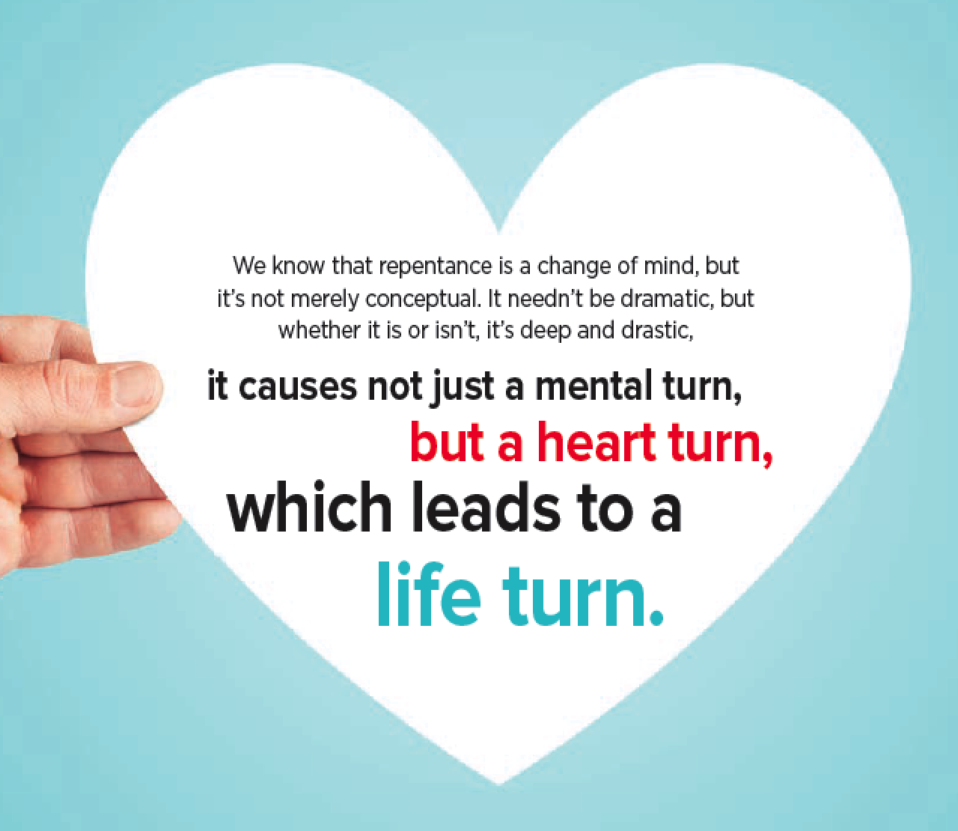
James isn’t a logician like the apostle Paul. His approach is more associative, and we see that he even repeats himself in places for emphasis—though not with the exact same words. We know that repentance is a change of mind, but it’s not merely conceptual. It needn’t be dramatic, but whether it is or isn’t, it’s deep and drastic, so much so that it causes not just a mental turn, but a heart turn, which leads to a life turn.
How can the worldly, discontented Christians James writes to repent? He tells them: “Submit yourselves . . . to God” (Jas. 4:7, English Standard Version). Put aside yourself and your own ideas long enough to see your creatureliness and sinfulness before a holy, sovereign God. Next, “resist the devil, and he will flee from you” (4:7), as was true for Jesus in the wilderness. The devil doesn’t want to lose valuable territory he’s gained in your life, so he’ll fight for it. Fight back, James says. Learn to fight instead of going with the flow, if the flow is away from God.
“Draw near to God” (4:8). He’s the one who can help you resist the devil. He’s even the one who enables you to submit. The promise is clear: Draw near to him, and he’ll draw near to you (4:8). That’s a promise to believe and act on, especially since we know God always keeps his promises.
Next James uses Old Testament imagery his Hebrew readers would be sure to recognize. As sinners, they are to cleanse their hands; and as double-minded people, they are to purify their hearts (4:8). His instruction recalls Old Testament ceremonies, but James isn’t interested in external rituals. They need to wash their hands, indicating being cleansed of sinful actions they’ve taken, things they have done. They need also to rid their hearts of the impurities that cause them to be double-minded, to blur the antithesis. This comes by submitting to God, resisting the evil one, and drawing near to God as Father through the Lord Jesus—not once, but habitually.
Not a Checklist
The spiritual and psychological posture and activity of all this is not mechanical or scientifically objective, like walking through steps in a lab, although it may look like that at first. It’s not something we mark off as having done in our calendar and move on. To one degree or another it’s devastating, potentially very uncomfortable. It’s a kind of death that happens so we may be able to live.
That’s why James calls his readers to “mourn and weep,” to let their laughter be turned to mourning and their joy to gloom (4:9). Here James recalls Old Testament wisdom literature, to which his readers were no strangers. In Ecclesiastes 7, we’re told “it’s better to go to the house of mourning than to go to the house of feasting” (v. 2). “The heart of the wise is in the house of mourning,” we’re told (Eccl. 7:4). If anyone lacks wisdom and asks God, this very well may be where he’ll be led.
Is James a killjoy? We see him as that if we take what he says out of context. “Sorrow is better than laughter, for by sadness of face the heart is made glad,” Ecclesiastes tells us (7:3). That’s what James is saying. It’s God who turns our mourning into dancing, David says in Psalm 30. It’s God who loosens our sackcloth so we climb out of it, and it’s God who then clothes us with gladness (Ps. 30:11).
The instruction here may not be popular, but it’s certainly clear. Some of the best-known verses in Scripture that people have memorized are in this section of James, held onto tightly because they are the promises of God, and God always keeps his promises. Resist the devil, and he’ll flee (Jas. 4:7). Draw close to God, and he’ll respond (4:8). Humble yourself before God, and you’ll be exalted (4:10), just like the Lord Jesus was after he humbled himself even to the point of death on a cross, not for his sins, but for ours. God exalted him above all (Phil. 2:8–10). We likewise then, like little Christs, or Christians, are exalted by God when we humble ourselves before him.
Not a Killjoy
James is no killjoy, but a theologian of the heart as well as of actions, or what he refers to as works. The two are integrated, after all. James shows, as David had in his day, that the result of repentance is God’s own exaltation. But he’s not done teaching his readers about Christian behavior. There’s a second wind, and we feel it in the final chapters of James, where he takes up how Christians are to treat each other, and where their confidence really needs to be. He also addresses the value of patience and steadfastness, especially in suffering, and the power of prayer and Spirit-led ministry among one another.
These are familiar themes in James. Earlier James was concerned about how his Christian readers used their tongues. Perhaps you’ve heard the term “cage-stage.” It refers to a relatively new Christian or someone new to the Reformed faith who’s come to an understanding of what it means to be righteous—not in himself but in Jesus Christ. That’s reason for excitement, to be sure. But often the excitement spills over into magnifying others’ shortcomings, seeing and talking about how perceptually people are not measuring up to what God says in the Bible. Meanwhile, the cage-stage Christian doesn’t see very clearly that he doesn’t measure up either, or much at all.
How can he? He has a plank in his eye that obstructs him from seeing clearly. Remember what the Lord says about that in the Gospels? He doesn’t say ignore your brother’s problems or sins. He says take the plank out of your own eye so you can truly help your brother with the speck in his (Matt. 7:5). There’s perspective for you! Whose eye problem is a bigger one? The answer is the one who’s looking around for faults, noticing specks—which are never hard to find—while he has a two-by-four jutting out of his eye and doesn’t notice it himself. It’s a comic picture, isn’t it? Someone zealous for correcting others who obviously stands in dire need of more correction than they. Sadly, for some this habit extends long past cage stage into old age.
What to Do?
Then how will anything get corrected, we may ask. Remember Jesus doesn’t say ignore the sins of others. Just don’t ignore your own in your zeal to correct others. Then you’ll know what to do and even how to do it, with the Spirit’s help. Restore them gently, the apostle Paul writes in his letter to the Galatian Christians, lest you too fall into sin (Gal. 6:1).
And so to this, James adds his voice: “Do not speak evil against one another, brothers,” he writes (Jas. 4:11). Who’s the one that will dwell on God’s holy hill, the psalmist asks in Psalm 15: the one “who does not slander with his tongue and does no evil to his neighbor, nor takes up a reproach against his friend” (Ps. 15:3). James’s Hebrew Christian readers would have been familiar with Leviticus 19:16, with which James’s admonishment resonates: “You shall not go around as a slanderer among your people. I am the Lord.”
This may have to do with eating certain foods. Early Christians, including many Hebrews, rightly understood the Old Testament dietary laws as expelled under the new covenant, with Christ’s coming. The dietary laws were about holiness or separateness, which Christianity through the Holy Spirit had absorbed and more fully expanded. Some Hebrew Christians, maybe more than some, had not come to this place of acceptance yet. One can only imagine the internecine warfare and the caustic accusations. But remember who the Bible names the accuser of the brethren—the devil (Zech. 3:1; Rev. 12:10).
James writes that to speak evil against a brother in Christ is to speak evil against the law and to stand as a judge, not only over one’s brother but also over the law (Jas. 4:11). What does he mean by this? Can we never call out what’s wrong in the church? After all, isn’t that what James is doing in his epistle? More next time.
Gerry Wisz is a writer, college instructor, and semiretired public relations professional who, with his family, is a member of Preakness Valley URC in Wayne, NJ.