


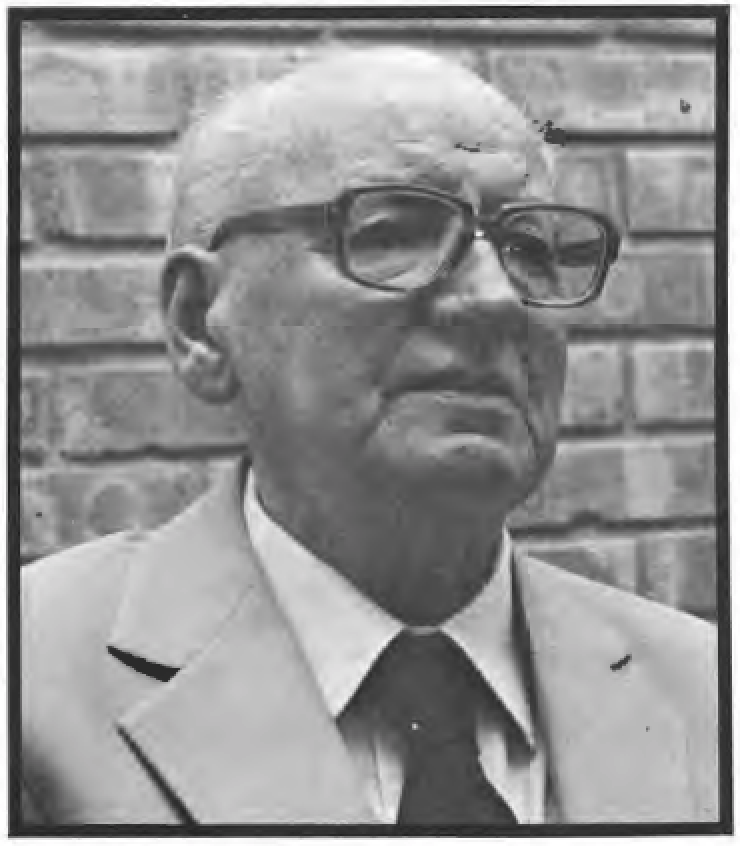
Rev. John Vander Ploeg served the Church faithfully and well for fifty–three years in the ministry of the gospel. He went to be with his Lord on Monday, September 26, 1983 some seven months after his wife of fifty-four years passed away. He was a delightful man to know, and he had a sharp mind that could see through issues in a clear and incisive way. His writings and speaking give evidence of that. He was an excellent debater, having been on the debate team at Calvin College in his student days, and never losing that clear, logical way of thinking. I often remember speaking with him, and having him ask question after question to understand precisely the point we were debating. It was one of these discussions that taught me something I have never forgotten. I was dating Nancy, his fourth daughter , at the time, and I had just finished my first year at Calvin Seminary. He said to me that the important thing that I had to learn was Berkhof. “You students must know Berkhof,” he said, “and then you can study other writers.” But I was a young man who knew everything , so I said, “O but Berkhof was just a compiler: he just took other men’s ideas and compiled them into his own dogmatics.” Well that was too much for Rev. Vander Ploeg. He set me straight right away, and let me know that no minister in the Christian Reformed Church can afford not to master the Reformed dogmatics of Berkhof. I found that he was absolutely right, as he was in most of the things we talked about.
Early Years
Dad Vander Ploeg grew up in a big family. He was one of nine children born and raised in the Grandville A venue area of Grand Rapids, Michigan. He grew up under P.Y. De Jong, the venerable “dominee” of the Grandville Avenue Christian Reformed Church. ‘“YP,” as he was affectionately called by his colleagues, was a strong influence in the young John Vander Ploeg, and in his family. The preaching that he heard from Sunday to Sunday paved the way for his own ministry because it was strongly Biblical and Reformed. During his student days he began to court his child-hood sweetheart, Henrietta Bouwkamp. His children and grandchildren used to laugh when Grandma told them that she and Grandpa had dated each other for ten years before they were finally married. But in those years, seminary students generally did not get married before their graduation and ordination.
His first church was East Paris, Michigan, at that time some distance from Grand Rapids, but now a suburb of the big city. He began his ministry in September of 1930, in the heart of the great depression. He served that church for nine years, and just before he left with his family for Pella, Iowa, the church installed inside plumbing for the dominee. When he accepted the call to the First Christian Reformed Church of Pella, Iowa, some people of East Paris felt that it was not very nice for the minister to leave just when the church put in this fancy plumbing.
Pella, Iowa
Dad always told me that every minister in the Christian Reformed Church ought to serve at least one church in Iowa. He was minister at the First Church of Pella for five years, and the people there still talk about Rev. Vander Ploeg. They enjoyed his ministry there immensely. It was during his stay in Pella that the congregation built a new church building.
He told me many years later that Dr. Peter E ldersveld joked with him about that. He said, “John, you really are slipping. In Pella, they built you a new church. In Lansing, they built you a new parsonage. And now when you are in Kalamazoo, all you got is a new garage.”
I remember the stories he told about his ministry in Pella. The people were extremely loyal to their town, and one older lady especially liked to talk about the fact that there was no place in all the world like Pella. Dad finally told her, with a twinkle in his eyes, that there was, in fact, one place that was better than Pella. She reacted instantly. “What place?” she asked. “Heaven,” was his reply. And she grudgingly had to agree that perhaps heaven was better than Pella.
The Dutch Language was spoken in Pella by many of the people. Actually it was a kind of “Yankee Dutch” in which the people “Englicized” their Dutch. One dear man would say in almost every sentence, “Met Ieven and wei zijn,” meaning, “If we live and are well.” One day when he and Dad were taking a walk in the cemetery he told Dad, “This is where my dear wife is buried, and met Leven and wei zijn, this is where I will be buried too.” Being a good pastor and listener, Dad never blinked an eye, but was happy to hear this information.
The battle for the Christian School was fought during those years in Pella. It was especially regarding high school education that Christian Education was at issue. One influencial man told my father-in–law that he listened to his sermons much like a person eating at a cafeteria. ”You pick up some food, and you leave what you don’t like, ” he said. “And that is how I listen to your sermons. When you preach on Christian Education, I just leave it.” But several years later, that man put his influence behind Christian Education in Pella too.
At another time, Dad was visiting an aged saint who was obviously dying. As he approached the man’s beside, Dad asked, “Are you ready?” The dear man replied with a twinkle in his eye, “Ja, dominee, are you?” It was a very fitting reply to the question indeed. But that was the kind of people that lived in Pella—saintly people, but with a charming sense of humor. And Dad and Mother enjoyed the church and the people.
Lansing, Illinois
In 1945 the family moved to Lansing, Illinois, where Dad became the minister of the First Christian Reformed Church. This was Chicago, and it was worlds apart from Pella, Iowa. The people were good, solid citizens of the kingdom of God. In Lansing, the problem was not the Christian School. It was mixed marriages. Often when young people would come to him to get married , and he would inquire into their faith commitment, he would be told that one of the parties was not a believer in Jesus Christ. It was always his conviction that the Bible teaches that such marriages are wrong, and therefore he had no right to officiate at them. It was therefore a source of much grief that a neighboring Christian Reformed minister would often willingly perform a wedding which, Dad following his own conscience, could not perform. Dad once told me about such a young couple who came to be married. The young man was from his church, and the girl was non-churched. Dad carefully explained what the Bible teaches about such marriages, and that this young man had no right to marry her. When he finished explaining everything to the couple, he asked, “Do you understand what the Bible teaches about this now?” “Oh yes,” they replied.
“Well then, what are you going to do?” Their answer was short, “Get married.” And then Dad would always tell me, “I’ve never yet won a battle with Cupid.”
Kalamazoo, Michigan
Grace Christian Reformed Church in Kalamazoo was perhaps the one church that the folks loved most of all. It was a church that came out of the Hoeksema/Danhof separation from the Christian Reformed Church. Rev. Danhof had been the pastor of the church for many years after the Protestant Reformed Church separated from the Christian Reformed Church in 1924. When the congregation came into the Christian Reformed Church, many of the members were not at all prepared to simply accept the transition without a fight. And so Grace Church had the reputation of being a difficult church. But with quiet diplomacy and good grace, Dad got along just fine even with the most recalcitrant members. I heard from many Grace Church people at the funeral home, “We just loved your father-in–Jaw.” The feeling was mutual.
During his ministry in Kalamazoo, when television was coming into its own and many people of the congregation were purchasing sets, the minister felt duty bound to warn the people against the dangers of watching television. One Monday after he had preached against watching worldly programs, a delivery truck dropped off a new television set at the parsonge which, the delivery man said, had been ordered by the occupant. Dad announced that it must be a mistake, for he certainly did not order such a thing. The next day another set came from another store, only to be given the same short shrift. This went on for some time, and the family never did find out for certain who the practical joker was. But the girls in the family thought that this experience had the makings of a little fun. One of the girls called Dad to the telephone, and the other girl, speaking on an extension, said in a disguised voice, “Rev. Vander Ploeg, we have the new television set that you ordered. Can we bring it today?” He exploded, “I did not order any television set, and I don’t want any delivered!” The girls just hooted , and he could also laugh at himself.
The Banner
The greatest period of influence in his ministry, of course, occurred when he was chosen by the 1955 Synod to be editor of The Banner. He was a delegate to Synod from Classis Kalamazoo, and he was chosen to be vice-president of that body. Although the Committee on Publications brought a nomination of four men to succeed Rev. H. J. Kuiper as editor, the name of Rev. Vander Ploeg was added to the nomination by a motion from the floor. And in the providence of God he was elected to be the next editor.
One of the first controversies that faced the church after he became editor was the “Infallibility Issue.” This occurred when a student at Calvin Seminary wrote an article in the Seminary paper in which he made certain remarks that appeared to question the infallibility of Scripture. This issue soon drew much wider attention through publicity in The Banner. If there was anything that was close to Dad’s heart it was love for the Word of God, and his unswerving desire to see Scripture upheld as the infallible, inerrant Word of God. It was at that time that I first came into contact with my future father–in–Jaw. He was asked to speak at a chapel exercise at Calvin College when I was a student there. He was asked to speak on the infallibility matter, because he had exposed some of the issues that arose within the confines of Calvin College and Seminary. I remember to this day the passage of Scripture that he used in strongly defending the ·absolute authority of Scripture.
The folks purchased a home in Cutlerville, Michigan, when Dad became editor of The Banner. He had a new garage built with a long drive way especially designed for shuffle board playing. When his daughters began to date, he always asked three questions of the young men. “Are you Dutch? Are you Christian Reformed? Does your car leak oil?” That was a standing joke around the house when Nancy and I began to date.
Mrs. Vander Ploeg was very active in the Pine Rest Hospital Circles, groups of women who raised money for Pine Rest. Through this association, the family was very close, of course, to Pine Rest. One day Dad went to the sheltered coffee shop which was maintained by Pine Rest to give work to some of the young people living there. One young girl came up to him and said, “Aren’t you Rev. Vander Ploeg?” “Yes,” he replied, and as he used to tell this story, he would say that he was really flattered that this girl knew him. Then she came back again a bit later, and said, “Weren’t you minister in Lansing, Illinois?” Again he said, “Yes, I was.” Finally she came back a third time, and said, ‘“Boy, they sure loved your wife in Lansing.” How he enjoyed telling that story. He always upheld his wife, and took pleasure in her accomplishments in the churches they served and in her work at Pine Rest. Once someone asked him if he was related to Mrs. John Vander Ploeg, president of the Pine Rest Circles. He answered with tongue in cheek, “Only by marriage.” Theirs was a good marriage, and the family grew up with a lot of fun and laughter. My mother–in-law, who was a great reader, kept up with all the issues facing the church during those years. I remember coming over to see their daughter Nancy, having a book by Friedrich Schleiermacher, the German theologian, with me. I laid it on a table in the house when Nancy and I went away. When we came back, my mother-in–law had read that book and she was full of questions about why seminarians were reading such a liberal theologian. Our meal times were filled with animated conversation.
Dad Vander Ploeg had a great love for the English language. Although he owned a number ofdictionaries, whenever a new one came on the market, he had to have it. As we were going over his books after his death, we found one after another that were worn out. His was not just a desire to have a dictionary for its own sake. He used them especially to know the correct pronunciation of the English language, as well as the correct usage of words.
As he grew older, Dad felt more and more the need for a new “school of the prophets” to train the ministers of the Christian Reformed Church. He felt that the teaching at Calvin Seminary simply did not satisfy the need for a strong defense of the Reformed faith and a commitment to the inerrancy of the Scriptures . In 1970 shortly after we moved to Sioux Center, Iowa, he came to visit us and to give the first in a series of lectures throughout the country on the need for a new seminary. The reception of this suggestion varied. Among many of the Christian Reformed clergy his speech was condemned. But many of the common people felt a kinship with his view. In his speech, he documented why he felt that the time was ripe for a new school. As all his work, this too was carefully based on facts which he had before him. Those who differed with him, often did so because of ·a bias toward the status quo, rather than because of an open-minded consideration of the incontrovertible evidence that had been building up in recent years. In spite of the opposition, Dad continued his efforts to promote a new seminary.
It was his great joy to hear that others had taken up this theme. When a meeting was ca lled in Chicago in 1980 to discuss the possibility of a new seminary, he and Mother were there. It was decided at that meeting to form a society for the establishment of a new school of the prophets. History has subsequently shown that the Lord has blessed those initial efforts of Dad Vander Ploeg, for the Mid-America Reformed Seminary is now a reality. The support for this seminary, especially in the mid-west, is phenomenal. God has truly blessed this effort. It was wonderful that Dad lived long enough to see the beginning of Mid-America Reformed Seminary.
The preaching of the Word of God is the heart of the church. This was Dad’s firm belief. He loved to preach, and he loved to hear good preaching. He always emphasized the need for clarity in preaching and the need for a logical outline based on the text. When we would talk together about a sermon that I was to preach in our church, he would always ask, “What are your points?” And then he would want to know what those points were based on. If they carne directly from the text, he would be satisfied. But he was impatient with preaching that had no clear and logical order. It was necessary, he felt, that the people go home with the sermon on their minds and hearts, and the only way they could do that was with a clear and orderly outline.
As his health began to fail because of congestive heart failure, he grew weaker. Still he kept up his correspondence with friends and colleagues. He continued to read , to write articles, and to write book reviews for The Outlook. Just a year before his death he joined the Book of the Month Club because he wanted to stay conversant with modern thought. He read most of those books, making comments in the margin. He also kept up his efforts to correct wh at he firmly believed were the errors in Calvin Seminary. Many people have said in criticism of Mid-America Reformed Seminary, that we should first take care of any problems in Calvin Seminary. Dad was active to the very end of his life attempting to do just that. He loved C;alvin Seminary, and it was his fervent desire to see a return to a strong Biblical commitment there. In fact, just one week before his death, he and his good friend, Rev. Fred Handlogten, went to the consistory of their church to request that an effort be made to right a wrong that he felt had been done by the Synod regarding an issue in the Seminary.
His personal faith in the Lord Jesus Christ was strong. His confidence lay not in his own work, but only in the righteousness of Jesus Christ. The night before he passed away , he told the family that he would not live much longer. I asked him if that was all right with him. His answer was a ringing, “Hallelujah!” He said, “I am a sinner, saved by grace.” That was his commitment, his faith. With such words and sentiments he went home on Monday, September 26. He had fought the good fight, he had finished the course, he had kept the faith!
When Rev. John Vander Ploeg retired in 1970 from editorship of The Banner he began editing this publication and continued to do so for some seven years, thereafter still giving help especially with book reviewing and occasional articles. In grateful memory of his many services the Outlook presents this sketch of his life. It was done by his son–in-law, the President of the Reformed Fellowship, and pastor of the Bethel Church of Zeeland, Michigan. The bereaved family are commended to the comfort of the Lord’s promises to His faithful people.