


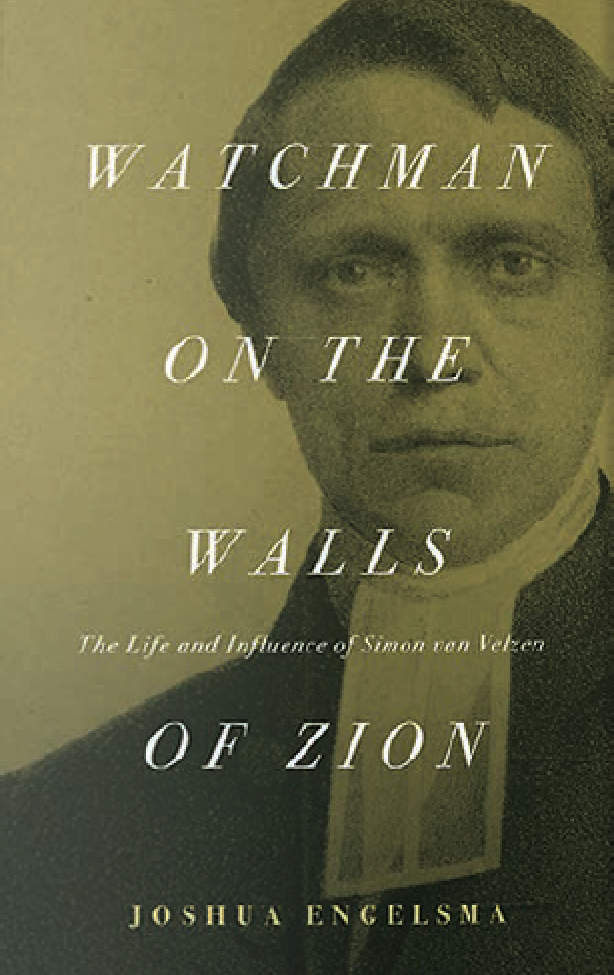
Watchman on the Walls of Zion: The Life and Influence of Simon van Velzen, Joshua Engelsma. Jenison, MI: Reformed Free Publishing Association, 2021. 229 pages. Hardcover. $26.50.
RFPA: https://rfpa.org/products/watchman-on-the-walls-of-zion
Who was Simon van Velzen? Unfortunately, there are many who might ask this—even many in western Michigan! Of those who led in the original secession from the Dutch church (Hervormed) in 1834, the names of Albertus van Raalte and Henry P. Scholte are known, but few know much about the other men used of God: Brummelkamp, de Cock, van Velzen, along with leaders who in some way had a part in the earlier years leading up to the Afscheiding of 1834: Schotsman, Witsius, and even a Brakel. (RFPA recently published a volume by Marvin Kamps on Hendrik de Cock.) As yet, as the bibliography included in this volume shows, at least for van Velzen very little is available in English. With this fine volume by a pastor in his first charge, another small but excellent step has been taken to provide material in English on this man. Engelsma has introduced us to this man of God who so many have misunderstood. This is not a ponderous book that many readers will put away as being too difficult to read. Rather it is one that is easy to read—and informative for God’s people today.
Simon van Velzen (1809–1896) was used of God to give confessionally Reformed people in the Netherlands and here in North America a place to worship God in spirit and truth. The times of the Secession were not easy— they were years of trials on every hand, years of fear. Yet God used men like van Velzen to proclaim his truth. Van Velzen was a man known for his faithfulness to God’s truth. Of course, he was a man who knew the weakness of men, for he was but man, but God anointed his lips and directed his life for God’s use.
We owe it to ourselves to read this short volume. Some love to sing “Faith of Our Fathers.” The writer of this so-called hymn was writing about the fathers of the Roman Catholic Church. Van Velzen was not one of these, but rather a father in on the Reformed faith. Read and learn what the fathers of the true faith did for God’s church!
Thanks, brother Engelsma, for your dedication and great interest. We look forward to other volumes about our church fathers.
Please visit www.rfpa.org/outlook to purchase or learn more.
A Practical Exposition of the Ten Commandments James Durham. Grand Rapids: Reformation Heritage Books, 2018. 377 pages. Hardbound. $30.00.
Lectures on the Book of Job: With Practical Observations James Durham. A new edition, corrected and revised. Grand Rapids: Reformation Heritage Books/Naphtali Press, 2018. 200 pages. Hardback. $23.00.
The author of these volumes, James Durham (1622–1658), was a well-known preacher in Scotland who stood with the Puritans and Presbyterians in the spiritual battles of those days.
The volume on the Ten Commandments focuses on the meaning of the Law— commandment by commandment. A preacher seeking fresh approaches to God’s law will find them here. The most lengthy exposition is on the fourth commandment. This is worth reading. Besides, there is included a fine explanation on the sin against the Holy Spirit.
This volume has long been out of print. After its publication in 1802, it appeared again two hundred years later. This is a carefully checked new edition with notes to bring the language up to date.
Are you looking for a small book to help you in your personal devotions? The book of Job will be opened up for you by using the second volume listed above.
Each chapter is explained in about four or five pages. Originally printed in 1759, and again in 1995 and 2003, this book has been revised, corrected, and updated so we can use it more easily. So important this work was considered to be that the great Charles Spurgeon included it in his well-known Commenting and Commentaries even though he had been unable to procure it for his own library.
Christ and the Law: Antinomianism at the Westminster Assembly, Studies on the Westminster Assembly, Whitney G. Gamble. Grand Rapids: Reformation Heritage Books, 2018. 187 pages. Hardback. $30.00.
Perhaps you have heard a minister speak of antinomianism in relation to Christian living, or perhaps you have heard a critique of the antinomian viewpoint. The word in question means “against the law,” and is the idea that the law is not needed for godly living. While these may be oversimplifications, they refer to a deadly theological cancer.
Dr. Gamble, associate professor of biblical and theological studies at California’s Providence Christian College, writes in the introduction to this fine historical-theological work that there were “differing positions on the nature of sin in the justified among the delegates to the Westminster Assembly.” Present were Arminians, antinomians, and the Reformed.
Our author gives an interesting study of the issue. Some may find that her points are not always helpful because of their own theological position, but all will be instructed concerning this heresy, as some in the Westminster days called it—and many properly still do.
Pierre Viret: The Angel of the Reformation R. A. Sheats. Tallahassee, FL, and Lausanne, Switzerland: Zurich Publishing, 2012. 323 pages. Hardcover. $30.00.
Available from Reformation Heritage Books: https://www. heritagebooks.org/products/pierreviret-the-angel-of-the-reformationsheats.html
There were many leaders in the days of the Reformation. Some are not as well-known as others. One of these men God used in the movement and development of this mighty work was Pierre Viret. The lack of knowledge about Viret is understandable since the author’s bibliography contains many volumes in French but only a couple in English. This makes this volume very valuable to the English reader. The publisher indicates that following this publication the author has been translating Viret’s original works in French to English.
Viret (1511–1571) was considered a model preacher of the Word. Illustrating his great ability was the fact that when he arrived at Geneva, so many wished to hear him that he was assigned to St. Pierre’s Church because of its capacity. For forty years his exposition of Scripture was a great blessing to God’s people wherever God placed him. The subtitle of this volume is a name by which Viret was known in his day because of his peace-loving spirit. In spite of this, he was ready to take a stand for God’s truth when it was necessary.
Viret was deeply concerned about the need for education to prepare men for the ministry. He formed a school called the Lausanne Academy. After some years things did not go well for it, and it was moved to Geneva, where it became the Genevan Academy under John Calvin.
In spite of Viret’s seemingly continual bouts with illness, often nearing death, he was used greatly by the Lord in those early days of the Reformation.
This well-worked-out volume, beautiful in production, filled with illustrations, will be worth your while to read. R. A. Sheats has done an excellent job of introducing this Reformer to us. Highly recommended.
A Tender Lion: The Life, Ministry, and Message of J. C. Ryle Bennett W. Rogers. Grand Rapids: Reformation Heritage Books, 2019. 380 pages. Hardback. $8.00.
The name of J. C. Ryle is well-known by more than a few of our readers. For example, his work on the Gospels is well-known and often used. He was a well-known evangelical in the Church of England—one who was humbled by seeing his influence being well-received. He was not among the Church of England’s leaders who desired to lead the church back to Rome. His stand was strong and his preaching was well-loved.
This volume is, as the notes on the dust jacket put it, an “intellectual biography” of this great preacher. Rogers is meticulous in giving the background of Ryle’s work. Sometimes, because of his deep desire to lay out the whole story, what he writes will be hard to follow for the normal reader of biographies. However, it is a thorough work, and it will give the reader a good picture of the trends and problems in the nineteenth-century English church.
For those who spend the worthwhile time reading this volume, it will become clear that Ryle was “a moderate, or evangelical Calvinist” who believed that Christ “tasted death for everyman,” that God loves all men, not just the elect. Further, he was a proponent of “a moderate premillennialism” (pp. 19–24).
Keeping this in mind, a reader will find much helpful insight into the English church.