


The Church’s Hope: The Reformed Doctrine of the End, Volume 1: The Millennium
David J. Engelsma. Jenison, MI: Reformed Free Publishing Association, 2021. 350 pages. Paperback. $29.95.
The discussion over a cup of coffee by the Lord’s people now often turns to Christ’s return, due to the events taking place all around us. Of course, we know that no one knows the day or hour of this great event. It could by far off in time. Yet, the events we read about in the news seem suspiciously like those we are told about in Scripture, and we wonder.
This volume of Professor Engelsma is the first of two on this important subject: the return of Christ. He lays out the scriptural teaching on the millennium. Placed before the reader is a discussion of the doctrine of the end with a necessary emphasis on the believer’s hope, the intermediate state (what takes place when we die, along with common errors, including soul sleep, purgatory, and others), the nature of the millennium, an explanation of Reformed amillennialism, and then a discussion of postmillennialism and dispensational premillennialism. These discussions are thorough in nature and strongly scriptural in approach.
More than one hundred pages lay out the errors of postmillennialism, and the same is true for dispensational premillennialism. Professor Engelsma spends some time focusing on Herman Hoeksema’s view of the loosing of Satan (which he finds questionable); the premillennial views of Revelation 20, Daniel 9, and Romans 11; and other emphases and issues. This present volume lays the foundation for a second volume. The “second volume will treat the other outstanding elements of eschatology, including lawlessness and apostasy in the last days, antichrist and the great tribulation of the saints, the second coming of Christ, the resurrection of the dead, the final judgment, and more” (xviii). (It is the intention of the publisher to provide all of Professor Engelsma’s dogmatics in future years, with these being the concluding volumes of the series.)
For anyone desiring to see what Scripture says about this important subject, here is another volume to get, read, and place alongside of William Hendriksen’s valuable works. A study of this work will inject some meat into these over coffee discussions. It is practical and very worthwhile.
This reviewer anxiously awaits volume 2 because of what will be included. He hopes it will include an index, along with a textual index (although the fine table of contents is extremely valuable until then).
Moses: Typical Mediator of the Old Covenant
Bernard Woudenberg. Jenison, MI: Reformed Free Publishing Association, 2021. 282 pages. Hardcover. $27.95.
What a book! Perhaps we have often read the portions of Scripture which lay out Moses’ life, and perhaps we have heard sermons on the passages opened up in this new publication; yet this handsome volume will still lay truths before the reader. Here in this life of Moses he is seen as the typical mediator of the Old Covenant who mediated between God and his church in those days when Israel was led out of Egypt on the way to the promised land.
Originally, these articles were part of a long series of some two hundred articles the author wrote for the Standard Bearer’s rubric “The Cloud of Witnesses.” (Perhaps there are other series in the Standard Bearer which could be made available as are these.) These forty-six articles lay out Moses’ work for his Lord during his 120 years on earth.
This volume, though its author engages in some poetic license, will lay before its readers the wonderful grace of God shown to God’s people in spite of their weaknesses and sin. Commenting on Numbers 14:13–19, Woudenberg writes:
This was the deepest love of Moses’ heart. It was true that he loved Israel, the people that he led. It was true that he loved the promise of God to bring them into Canaan land. But more than anything else, he loved his God and was jealous for the glory of God’s name. He desired with all his heart that the goodness of God should be revealed and maintained unto the ends of the earth. For this he first pleaded, and from this derived all the rest. There was nothing on Israel’s part that could be pleaded as an excuse for what they did. There was no virtue on Israel’s part that warranted that their sin should be overlooked. There was only one thing that demanded Israel’s preservation. God had promised forgiveness and redemption, and for his name’s sake Moses pleaded, “Pardon, I beseech thee, the iniquity of this people according unto the Greatness of thy mercy” (Num. 14:19). (219)
Each chapter is short, though filled with good material. Quoting from Augustine’s experience, “Take up and read,” it will help you to see how God works through his people and how marvelous are his ways and plans.
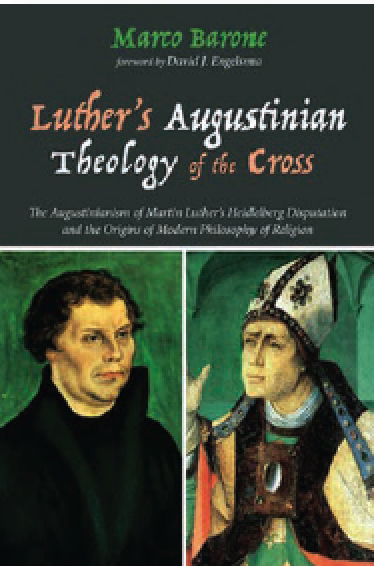
Luther’s Augustinian Theology of the Cross: The Augustinianism of Martin Luther’s Heidelberg Disputation and the Origins of Modern Philosophy of Religion
Marco Barone. Eugene, OR: Resource Publications, 2017. 145 pages. Paperback. $21.00.
If we read about the Reformation, we soon learn that it was much more than a moment in 1517 when Martin Luther nailed the Ninety-five Theses on the church door at Wittenberg. It was a slow unveiling of the gospel. In a very real sense, it was a return to at least a portion of Augustine’s teaching, but not all; indeed, a return to the theology of the Bible. This had been long covered up by man’s philosophy.
Only a few months after the posting of the Ninety-five Theses, Luther, whose life was threatened by Roman Catholics for his firm stand on truth, was appointed to attend the Augustinian convention held at Heidelberg. He was there to present his theology of the cross, in ninety-five theses. Luther’s presentation of the gospel was thoroughly biblical, and it certainly reflected what Augustine had taught.
He strongly emphasized that man had fallen from a state of innocence to one of utter misery and depravity. Man lost his free will, so that now he is free to do only evil. This, of course, is laid out by Luther in his Bondage of the Will. He emphasized that only through the cross do we know redemption. Luther clearly taught that man cannot reason his way to God. God must come to us. Pelagianism and Semi-Pelagianism, by contrast, speak of a free will by which man is able to freely choose between good and evil. Also, man becomes righteous by activities or works which bring him to reach moral goodness. Augustine had to deal with Pelagianism and its ugly effects. We still have that corruption around us in Arminian preaching and popular so-called Christian novels.
Although historically Augustine was a teacher of truth when it came to the doctrine of salvation, the church today, as did the Church of Rome so long ago, has turned its back on the truths which Martin Luther taught already in his earliest days as a Protestant. As you spend with this book you wonder where that true doctrine has gone. Besides, many so-called religious philosophers like Kant and Leibniz have their way of corrupting the church. In the face of this, Luther would defend this thesis: “He is not righteous who does much, but he who, without work, believes much in Christ.”
This excellent work is not for recreational reading. It is for a student of theology. One who works through it will be richly rewarded.
Jerome Julien is a retired pastor and a member of Walker United Reformed Church in Grand Rapids, MI.