


Augustine of Hippo lived and worked in the intermediate age after the decline of classical civilisation before the beginning of western culture. Though this period is sometimes neglected, it was the era of the first great doctrinal controversies and theological definitions. By the time of his death in 430 Augustine had become well known as one of the foremost defenders of the faith. As a Bishop of the Church in Africa he had to deal with one breakaway Donatist sect who used violent methods to assert their exclusive claims. More well-known is the long drawn out controversy against the Pelagians who held that man by his free will could merit grace. The writings of Augustine form the response of a great Christian thinker to the pressing needs and problems of his day, yet they contain much that is of interest and profit to us now. And learning from one of the early church fathers can balance out any tendency to consider church history as having started with the Reformation!
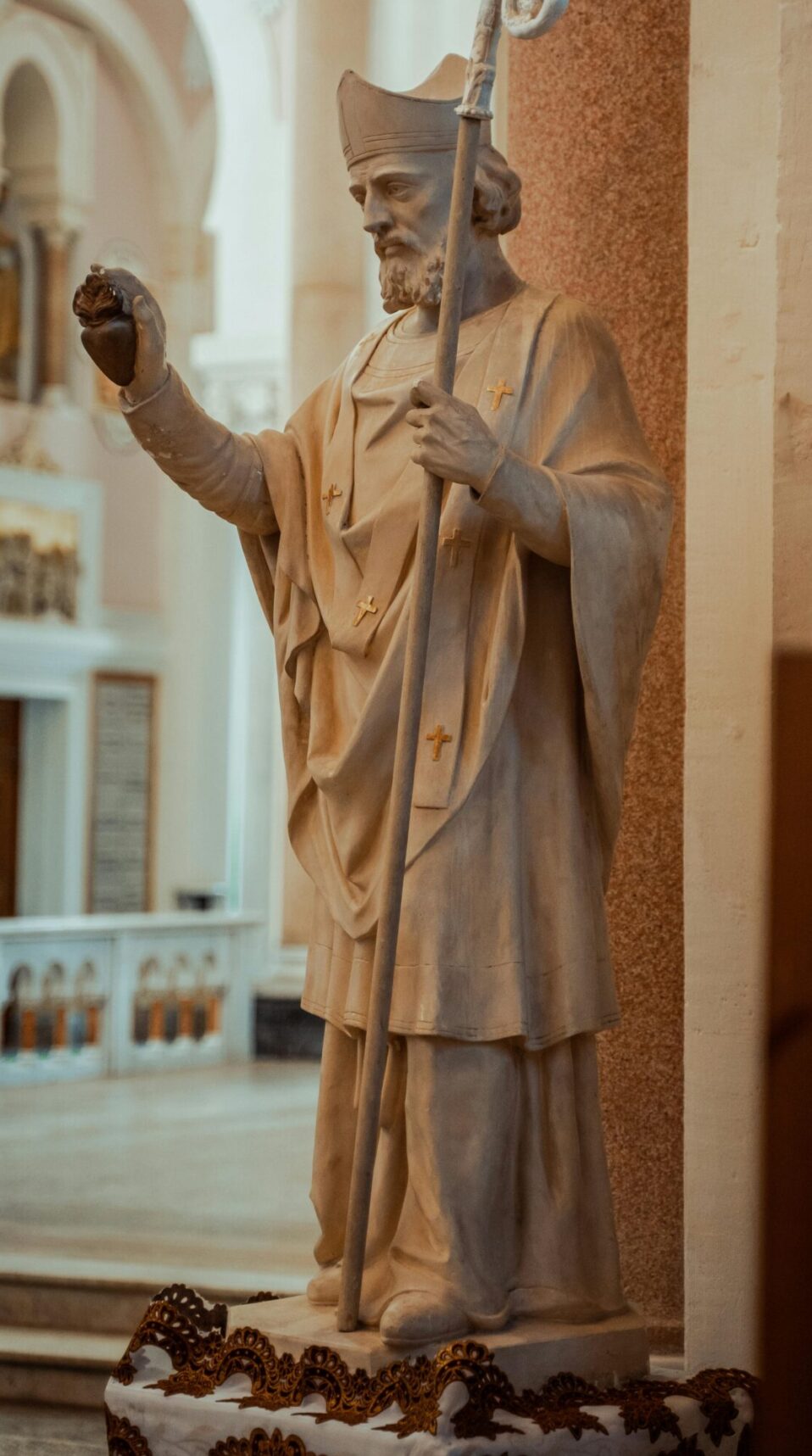
The Confessions
This is perhaps the most widely read of Augustine’s works. Here if anywhere is a convincing account of God’s irresistible grace reaching out to save and to use one who, with Paul and later Bunyan, regarded himself as the chief among sinners. We have Augustine’s own account of how as a brilliant young teacher of rhetoric he engaged on a search for ‘truth’, but in reality was fighting against the Holy Spirit. God however honoured the persistent prayers of Augustine’s mother, and used the preaching of Ambrose as well as the reading of Scripture to bring him to repentance. It is to be hoped that the recent publication of a ‘modern English’ translation! will encourage many more Christians to read and profit from the testimony of this fourth century Christian. This book could also be given to our non-Christian friends who are searching, as Augustine himself did, for truth. It is a powerful witness to the fact that God has indeed made us for himself, and our hearts are restless until they find their rest in him.2
The City of God3
This second book is a work on a different scale altogether. If the Confessions are a heartwarming demonstration of the truths of salvation, we find in the City of God the theological foundation for these truths. ‘I have taken upon myself the task of defending the glorious City of God against those who prefer their own gods to the founder of that City’ wrote Augustine at the beginning of this massive work. He was writing in response to the sack of Rome by barbarians in 410 BC, which had triggered off a pagan reaction towards Christians, as it was thought that pagan gods had protected Rome in the past. This traumatic event also resulted in deep uncertainty among many Christians who had begun to identify the kingdom of God with the Roman Empire.4 Now their whole world seemed to be crumbling. Augustine encourages them—and any Christians who see themselves as standing at the end of a civilisation—by showing that the City of God is eternal. In defending it he found himself expounding the central truths of God’s redemptive and creative work. And so, amidst many polemical and topical sections, some fascinating, and some frankly boring digressions, we find gems of biblical exposition and wonderfully clear statements of truth.
All is seen in terms of the contrast between ‘the two cities, one of God, the other of this world.’ One definition is as follows: ‘I classify the human race into two branches; the one consists of those who live by human standards, the other of those who live according to God’s will. . . . By the two cities I mean two societies of human beings, one of which is predestined to reign with God from all eternity, the other doomed to undergo eternal punishment with the devil.’5
The City of this World
Some have thought of Augustine as a complete pessimist because he clearly stated the absolute inability of a ny political, legal, economic or social system to bring about the ultimate good of man; all these things being part of the City of this world. In fact his was only the ‘pessimism’ of one who recognises the consequences of man’s fall into sin. God created man perfect, but when his will was transgressed man died, in that every faculty was to some degree corrupted. ‘God created man aright, for God is the author of natures, though he is certainly not responsible for their defects. But man was willingly perverted and justly condemned.’6 After the fall, Cain founded a city,7 a forerunner of all earthly states, founded on self love,8 and beset with quarrels, wars, battles, death.9 Augustine sets out to prove decisively that the world can never provide true justice, justice being the conformity to order that God wills for all men.10 Nor can the world give real happiness, which comes from serving God.11 In practical terms the members of the earthly city show themselves by living for temporal concerns alone.12
The City of God
Given the utter depravity of man, his only hope of salvation is found in the free grace of God extended to those he has elected in eternity.13 If Cain belonged to the city of man, ‘the other son Abel belonged to the City of God . . . one who was a pilgrim and stranger in the world . . . . He was predestined by grace, and chosen by grace, by grace a pilgrim below, and by grace a citizen above. As far as he himself is concerned he has his origin from the same lump which was condemned as a whole lump at the beginning. But God like a potter made ‘out of the same lump one vessel destined for honour and another for dishonour.’14 15 And how are citizens of this Heavenly City made? Augustine gives the answer in many places. For instance: ‘When we were overwhelmed by the load of our sins when we had turned away from the contemplation of his light and had been blinded by our love of darkness … even then he did not abandon us. He sent to us his Word, who is his only Son, who was born and who suffered in the flesh which he assumed for our sake . . . so that we might be purified from all our sins by that unique sacrifice.’16
Anyone, ‘if he is reborn into Christ and makes progress’17 is a member of ‘that Republic whose founder and ruler is Christ’.l8 Augustine made it clear that those who are reborn are not necessarily all members of the church—he thus made the distinction between the visible church and the invisible City of God. Ultimately only God knows his elect. ‘While the City of God is on pilgrimage in this world, she has in her midst some who are united with her in participation in the sacraments but who will not join her in the eternal destiny of the saints.’19
The Grace of God Shown Even in the Earthly City
God shows a particular love to the elect, but Augustine shows that grace is extended to maintain an order that embraces even the unrighteous.20 Without this restraint man could not survive, for his fallen instincts would inexorably lead to anarchy. Order is achieved through means adapted to man’s unrighteousness—the state, government, slavery, property. God is in absolute control of all these affairs. If he has taken meticulous care in creating the physical world ‘it is beyond anything incredible that he should have willed the kingdoms of men, their dominions and their servitudes to be outside the range of the laws of his providence.’21 The beauty of the created world is to the advantage of all mankind, saved and unsaved. Of such beauty Augustine showed a keen appreciation, writing of: ‘The manifold diversity of beauty in sky and earth and sea, the abundance of light, and its miraculous loveliness, in sun and moon and stars, the dark shades of woods, the colour and fragrance of flowers; the multitudinous varieties of birds, with their songs and their bright plumage, the countless different species of living creatures. . . . Then there is the mighty spectacle of the sea itself, putting on its changing colours like different garments, now green, with all the many varied shades, now purple, now blue.’23
The Christian in the World
The common grace extended to the whole world ensures a certain order, so that the children of God may worship him in peace without fear of anarchy. But what is our rule as believers in this present order? Augustine had much to say on this subject.24
(a) ‘God is to be worshipped as well for temporal as for eternal benefits’25 he wrote. We are to appreciate the beauty of God’s creation; have gratitude for a measure of peace and restraint on evil; depend on God for all earthly goods. Such temporal blessings are not to be underestimated. ‘Anyone who exalts the soul as the Supreme Good and censures the nature of flesh as something evil is in fact carnal alike in his cult of the soul and in his revulsion from the flesh.’26
(b) However, the Christian must have a transformed and spiritual attitude to these earthly things. We must always know that ‘the inferior goods of the world, although essential for this transitory life, are to be despised in comparison with the eternal blessings of that other life.’27 Citizens of the Heavenly city may be discerned in that they ‘refer those (earthly) concerns to the enjoyment of eternal peace.’
In certain cases a passive attitude to the ordering of earthly affairs is called for: ‘the servants of Christ are enjoined to endure even the most wicked and vicious commonwealth, if so it must be, that so t hey may by this endurance purchase for themselves an eminent place in that most holy and august Parliament of angels and in the celestial republic where the will of God is law.’28 Such submission will, says Augustine, be a consistent and positive witness to the transforming power of Christ.
(c) In more favourable circumstances it is God’s will that his people play an active part in the maintenance of order and peace in the world. A believer may participate in political activities,29 wrote Augustine, as long as he remembers that the aim of these activities is fundamentally different to the aim of spiritual activities. In participating in state affairs a Christian cannot expect to change the hearts of other men and he has to use ‘rough’ means of justice; law courts, sentences, even the death sentence; remembering that they are part of God’s providence . to the sustaining of order in the universe among unrighteous men. Such means, suitable for the city of this Earth, are very different to the means appropriate in the city of our God, where tenderness rather than coercion is the rule.
(d) Augustine does not therefore enjoin Christians to abdicate responsibility in the Earthly city. His very clear conception of two cities in no way involves a ‘sociological separation’ in this world because until the Judgement men are being saved from Babylon to Jerusalem. Indeed it was a sect against whom Augustine contended for most of his life (the Donatists) who envisaged the Christians’ separation from the world in literal terms. We are to regard the world as a temporary abode, but while in it we should contribute as we are able to the maintenance of the order ordained for it by God. That this order exists at all is a sign of the forbearance of God, though it is only an ‘image of justice’ compared with the ‘vera justitia’ in God’s kingdom. It is to this eternal kingdom that the believer’s ultimate allegiance must be given. So while we must be salt and light in the world, with Augustine we look forward to ‘the eternal rest not only of the spirit but of the body also. There we shall be still and see; we shall see and we shall love; we shall love and we shall praise. Behold what will be, in the end, without end! For what is our end but to reach that kingdom which has no end?’30
NOTES
1. The Confessions of Augustine in Modern English translated by Sherwood Eliot Wirt. Asian Lion Paperback 1978. £1.75.
2. Confessions 1.1.
3. It is certainly not to be recommended that the attempt be made to read this ‘cover to cover’ but some may find, as I did, that to invest 3.50 in Henry Bettersons’s translation (Penguin Class ics 1972) is well worthwhile. All quotations are from this translation.5. City of God 15.1.
6. 8.14. 7. 15.5. 8. 14.28. 9. 15.4. 10. 19. 11. 14.25 and 5.24.12. 14.28.
13. 15.1
14. Rom. 9:21.
15. City of God 15.1.
16. 7.31. 17. 15.1. 18. 2.21. 19. 1.35. 20. 5.11. 21. 5.11. 22. 22.24. 23. 19.13. 24. Esp. 19.14. 25. 11.14 cf. 22.24 for a wonderful list of ‘the good things of which this life is full even though it is subject to condemnation.’ 26. 14.5. Augustine had himself been associated before his conversion with the Manicheans. This sect held a dualist view of the universe such as it here and elsewhere refuted. 27. 19.13. 28. 2.19. 29. 19.17. 30. 22.30.Reformation Today is a bi-monthly magazine published by the Cuckfield Baptist Church, Sussex. England. It recently celebrated its 10th birthday and is edited by Rev. Erroll Hulse, who in 1966 published the little book, Billy Graham – the Pastor’s Dilemma. It presents a Reformed Baptist viewpoint and contain many excellent articles. This article by Sharon Hulse, daughter of the editor, who is graduating from a B.A. honors program in History at Cambridge University, is reprinted by permission from the November-December, 1979 issue of Reformation Today.