


The century from the early 1400’s until the early 1500’s (which I will call the fifteenth century) in western Europe was a period of many sweeping changes. The Middle Ages transformed into the Renaissance. The feudal system ended, and the invention of the printing press allowed changes in society that led up to the Reformation.
To show the contrast between how things were and how they changed, I will give historical examples of both in discussing the following highlights.
Pilgrims And Their Journey
For my studies at Utrecht University in Dutch Medieval Literature, I had the privilege to scour the libraries in the Netherlands for manuscripts of Dutch pilgrims who not only traveled to the Holy Land but extended their pilgrimage with a journey through the desert to Sinai. I found a total of seven travel logs, five of which were from the fifteenth century. Throughout the Middle Ages, there were people who wanted to combine their adventurous spirit with visiting relics and earning indulgences. But traveling through the Sinai desert was certainly not for the faint of heart. Says Jan van Berchem: “We needed five camels, because two persons ride on a camel in small baskets or wooden boxes which are very uncomfortable and cramped.” Those baskets were hanging on the sides of the camel and one had to actually sit in it the whole time.
The route at first was along the Red Sea (“not really red, but the sand is red”) followed by a five-day journey inland. The desert is just stone and sand, no vegetation, and deep ravines where water only flows if it has rained somewhere else. Jan or Anselm Adornes said: “We were traveling mountain up, mountain down, without ever knowing where we were, for a whole half day. Also we couldn’t find any water that day, so we had to live without anything to drink. The next day, around noon, in a valley we found water, but God knows what kind: stinking like a leek, full of vermin and muddy and dark. Our camels drank out of necessity, because they had not had anything to drink for four days, but we couldn’t stand the smell and gross taste, no matter how much sugar we put in there. We couldn’t find any water in the two following days, so some of us became very faint and were afraid to die. But God be praised, he foresaw it, because soon after we saw the monastery of Saint Catharine; we were so elated that we all felt healed.”
In the middle of the Sinai desert was—and is—a monastery called St. Catharine’s. It was established around 550 AD on an oasis and takes its name from the relics of Saint Catherine of Alexandria. Her body was found in the mountains and kept by the monastery until sometime during the Middle Ages, when all of her bones were dispersed as relics.
Within the monastery walls there are several buildings and, of course, a chapel. Behind the chapel there are still some shoots of the burning bush, where Moses had to take off his shoes because the ground was holy (Exod. 3). You’re still advised to take off your shoes there.
Next to the monastery is a high mountain called the Moses Mountain. It has 7000 stone steps to the top, where (supposedly) Moses received the Ten Commandments. When you reach the top, you can see an even higher mountain called St. Catherine’s Mountain, which was also climbed by the pilgrims, although it was a much higher climb. Adornes says: “This mountain has no stairs, which was sour for us, because often we were climbing straight up, like climbing a tree from branch to branch; it was terrible there and the higher we climbed, the more terrible. . . .” Yet most pilgrims climbed both mountains in one day!
Most pilgrims stayed for about four nights in the monastery. The names of Jan and Anselm Adornes are still engraved in the wall of the guesthouse. They were there August 24–30, 1470.
It’s no coincidence that most of the travel diaries I found were from the fifteenth century. In the Middle Ages, the pilgrims traveled in groups under the leadership (and sponsoring) of a noble man, but the Renaissance that reached western Europe in the fifteenth century brought more emphasis on the individual; the pilgrims realized they could write their own travel logs that could be read by others.
Bernhard van Breydenbach was one of those pilgrims. He was from Mainz (where the printing press was invented) and he made his journey to Palestine and Sinai in 1483. The preconceived purpose for his pilgrimage was to have his travelogue printed so it could be a travel guide. He even took an artist along, Erhard Reuwich from Utrecht, to make the illustrations. His book was printed in Latin and in Dutch.
Jacob van Maerlandt and Johannes Gutenberg
It is interesting to see the difference in impact before and after the invention of the printing press. Around 1270 AD, at the height of western Europe’s Middle Ages, a Dutch author, Jacob van Maerlandt, among many works, retold the Bible in (Medieval) Dutch. It was carefully handwritten and hand copied in the many scriptoria all over the country and it was beautifully illustrated, even with gold foil, by skilled artists. These manuscripts, written on parchment (which is made from animal hides), are a joy to behold. Rich noblemen would sponsor the authors and illustrators and only the clergy in the many monasteries would read them. Noble women would have personal prayer books written and illustrated, because they could usually read and those little books were also precious works of art.
There are fifteen copies still existing of Van Maerlandt’s Bible, which shows that it was very popular. And even though he also wrote a work in which he criticized the church, he was never considered a threat because it never reached the common people.
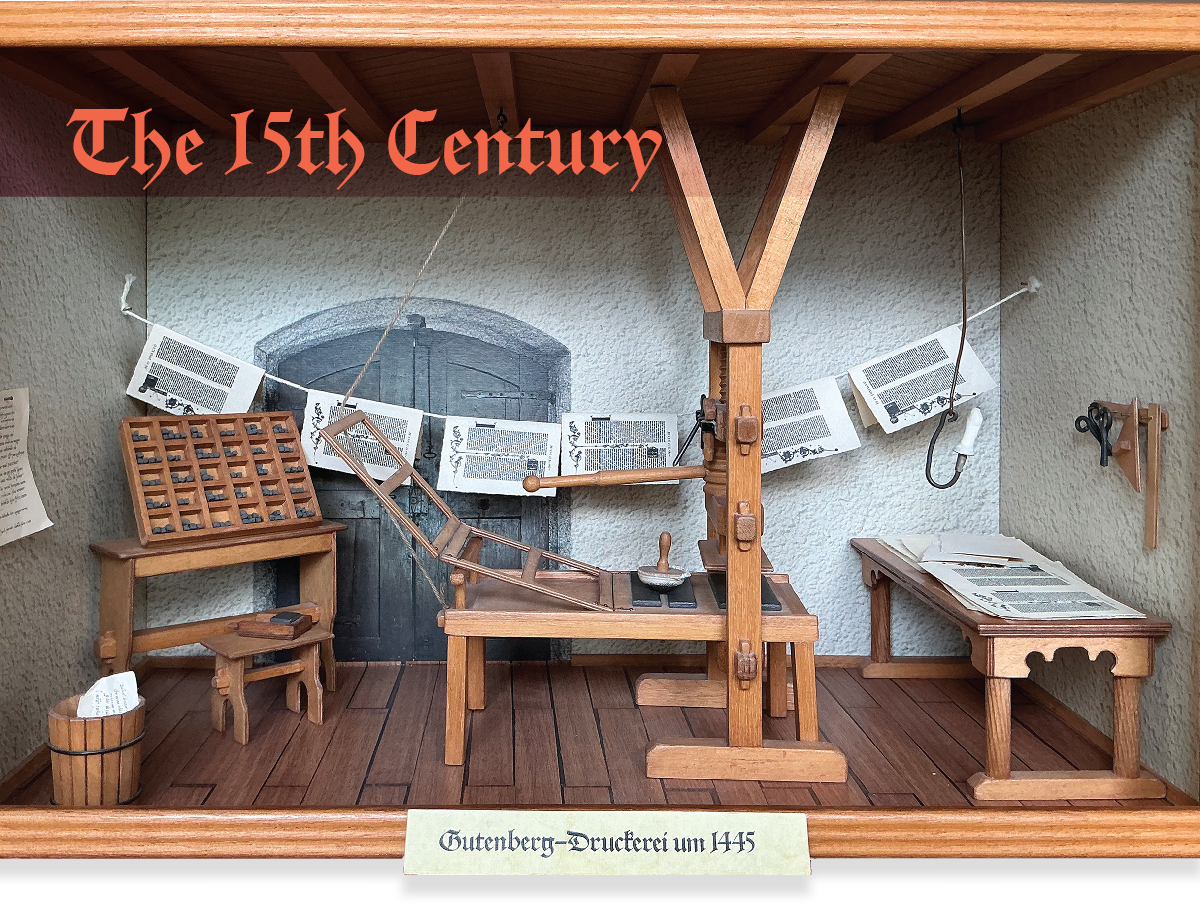
Sometime before 1440, in Mainz (Germany), a man named Johannes Gutenberg was a goldsmith who wanted to get into the business of making pilgrim’s badges and tokens (they were the only mass-produced items at the time). When he couldn’t find investors, he disappeared from view for awhile, very secretive about his doings. In 1440, he appeared again with his invention of the printing press. He not only designed the screw press itself, but also the metal movable type, the hand mould, the recipes for the ink and the paper—in short, everything necessary for the printing press. The fact that more countries claim the same invention proves that the time was ripe for it.
In 1454, Gutenberg put his press to commercial use, producing right away thousands of indulgences for the church and also the famous Gutenberg Bible. As early as 1480, there were printers active in 110 different places in Germany, Netherlands, and most other western European countries. Books were suddenly made for the masses, leading to increased literacy and the spread of knowledge and ideas. It’s impossible to do justice to the scope of changes that this single invention has brought. The printing press invented the news and really the mass media. This technological innovation can even be seen as the beginning of the scientific revolution.
It can also be seen as the end of the Medieval caste system of noblemen, clergy, and common people. This latter view is expressed by Johan Huizinga, who wrote in 1919 his famous book entitled The Waning of the Middle Ages (from the Dutch: Herfsttij der Middeleeuwen). The church and nobility were losing their control over the masses—but they didn’t go down without a fight that would last for centuries.
Reformation And Censuring
If we consider reformation to be a religious awakening primarily sought to correct abuses within the established ecclesiastical order by elevating the Bible’s authority personally and (where possible) within the church, then there was already a reformation in fourteenth-century Netherlands. It was called Modern Devotion and the reason it didn’t spread all over western Europe was probably the fact that it happened before the printing press.
Gerard Groote (1340–1384) was a Dutch Catholic deacon who was a popular preacher and the founder of the Brethren of the Common Life. He was a key figure in the Devotio Moderna movement. Its precepts were later further disseminated in texts such as The Imitation of Christ by Thomas à Kempis, because he did live during the invention of the printing press. The main point of the Modern Devotion movement was the denial of one’s own self to be achieved by silent meditation. It was also lived out in everyday life; for example, Geert Groote started in Deventer several hofjes which were small row houses that enclosed a communal garden, where widows could live safely and practice their trade.
When, over a century later, Martin Luther (1483–1546) hammered his ninety-five theses on the door of the church in Wittenberg, he knew to dedicate them to the Bishop of Mainz; Wittenberg is only 300 miles away from Mainz, where the printing press had been in full swing since 1450.
Without the printing press, the Reformation could have never been as successful and quickly spreading as it was. But wherever printers set up shop, censorship wasn’t far behind. A good example of this is the Bible translator William Tyndale. He was banned from England because of his New Testament translation in English (1526), meant for the common people.
By the time he wanted to revise his work in 1534, over thirty thousand copies were circulating already in England. But Tyndale himself had to live in Antwerp, where many good printers and good trade routes with England were to be found. He never finished the Old Testament because he was betrayed, arrested, put in a dark dungeon, and eventually strangled and burned by a self-congratulatory church and civic officials.
Until This Day
There is much that connects us to the people who lived six centuries ago. Pilgrims made religious journeys and we still do that, too. They traveled to far away places and so do we. I even traveled in the footsteps of the pilgrims to the Sinai. They created the travel stories and the illustrated travel guides that we still enjoy. They were travelers who wanted to be known for their travels rather than for their religiosity.
The printing press started a revolution out of which we now have our mass media, and social media comes from that. Now we have Artificial Intelligence (AI) that is changing society as fast and drastically as the printing press did in the fifteenth century.
How the connection is still felt can be seen in the following recent quote from Jeff Childers’ Substack. Although he is talking about the future of the medical world, in his Substack article of 6/27/2025, called Coffee & Covid, he wrote the following: “In the 1400’s, Johannes Gutenberg invented the printing press, to mass-produce English-language Bibles, and in doing so lit off a bloody civil war between priests and penitents. What had once been the exclusive domain of Latin-speaking clerics -the interpretation of God’s word- was now suddenly accessible to every farmer, merchant, and cobbler who could read. The church called it heresy. The people called it revelation. For hundreds of years, Popes fulminated volcanically. Monarchs maniacally burned books. Reformers were burned on stakes. And everything changed. AI is to the medical profession as the printing press was to organized religion.”
With the Reformation, a fundamental philosophical shift about the nature and value of humans occurred. This shift was positive in the sense that more people came to personal saving faith, but in our time the emphasis on the individual has led to excesses which can be plain evil. We need to be discerning that we keep the good that the Reformation brought, and reject any evil temptations that will come into our lives also. We’re living in a time that is changing as rapidly as the fifteenth century, but by following the perfect example of the Lord Jesus and the Scriptures He affirmed, our Christian ancestors were a blessing in their day and Christians today can repeat this.
Mrs. Annemarieke Ryskamp was born and raised in the Netherlands. She graduated with a master’s degree in Dutch Language and Literature from Utrecht University and worked for the Dutch l’Abri and as a secondary school teacher at United World College in Singapore. She attends Dutton United Reformed Church (MI).