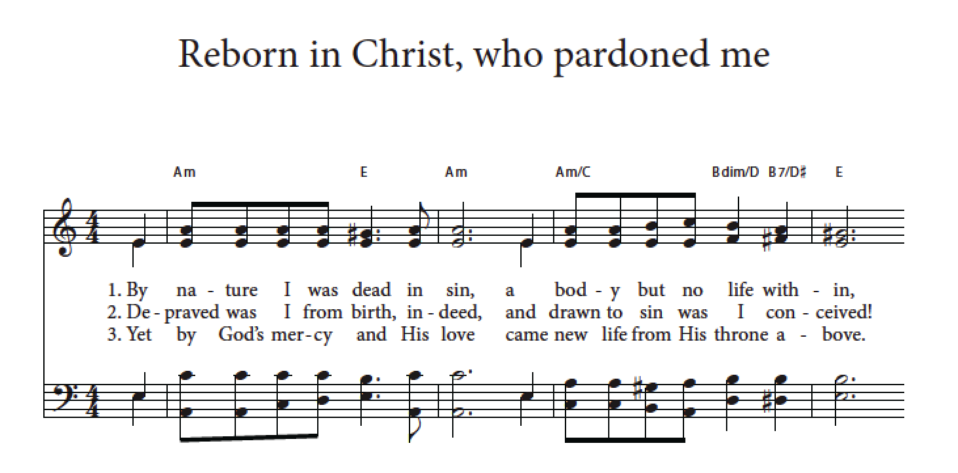
When Rev. Brian Najapfour explained the origins of the song “Reborn in Christ, Who Pardoned Me,” he informed me that its original proposed title was “Total Depravity.” Perhaps that’s a bit of a turnoff for a first encounter with a new hymn. And yet it’s worth pondering: How many well-known hymns can you think of which specifically and directly address the doctrine of total depravity? Despite an abundance of historic texts on the atonement (“And Can It Be?,” “Not What My Hands Have Done,” “How Vast the Benefits Divine,” and countless others), our Reformed library of hymnody has little to say about the natural condition of humanity before regeneration. Rev. Najapfour’s composition succeeds in combining the theme of guilt before God with the other two strands of the gospel— grace and gratitude—into a single piece of poetry which affords worthy meditation for all believers.
There is precedent for God’s people to sing about the depths of human wickedness, as a majority of the Psalms attest. Consider Psalm 14, which reflects on the sad condition of a world in which “there is no one who does good, not even one.” Rev. Najapfour’s text personalizes this observation: I have not done good; I have not sought God. Psalm 14 links human reason and affection under this curse: a lack of understanding leads to the absence of a desire for God. Similarly, Rev. Najapfour’s hymn articulates how the Fall bears upon my physical and spiritual senses (“Satan had destroy’d my sight”), my affection (“To Christ my heart was not inclined”), and my intellect (“Satan had ensnared my mind”). Yet Psalm 14 ends not with despair but with the hope of salvation, and the third and fourth stanzas of this hymn describe this salvation as already accomplished. I am made alive first in terms of spiritual sight, and second in terms of awakening my spiritual hunger for “Jesus Christ, the Living Bread.” The result is a triumphant conclusion with an evangelistic call: “come join with me!”
Bob Azkoul’s tune CEDAR TREE, composed specifically for this hymn, seeks to convey the progression from a dead and stagnant corpse to a living and joyous believer. The dark and foreboding minor harmonies of the first two stanzas transform into a jubilant major key in the third and fourth stanzas, centered on the phrase “praise to his glory!” This change of pattern in the middle of an otherwise familiar hymn structure may pose a challenge to first-time singers, but the second half of the tune preserves some of the basic rhythm and motifs of its first half, making the transition easier.
“Reborn in Christ” is an admirable contribution to the growing effort to articulate more fully the doctrines of the Reformed faith in musical form. The novelty and the uncommon subject matter of this hymn should not deter Christians from giving it a try in family worship or congregational singing. Rev. Najapfour and Mr. Azkoul are to be congratulated for their work, with the hope that they will continue to produce beautiful and biblical hymns that serve the churches.
Michael R. Kearney is a graduate student and research assistant in the Department of Communication and Rhetorical Studies at Duquesne University in Pittsburgh. He is a member of Covenant Fellowship Reformed Presbyterian Church (RPCNA) in Wilkinsburg, PA.