


How do you respond to a Christian man who is in his twenties and says he doesn’t really want to get married? What if he says he’s unsure of marriage? Similarly, what if there’s a young Christian woman you know who has serious reservations about marriage? These types of questions aren’t always easy to answer. Furthermore, the topics of marriage and singleness are big ones: where do you even start?
Before answering those questions, it is worth mentioning that Americans are more and more moving away from marriage relationships. It is relatively common today for average twenty-and thirty-somethings to remain single while engaging in romantic and sexually intimate relationships. As some have said, we live in a “hook-up” culture. People often hook up but for various reasons do not make a lifelong marriage commitment. It doesn’t seem like this anti-marriage trend will change any time soon.
This trend is important to note because sometimes Christians get blown along by the winds of culture without knowing it. When this happens, Christians slowly move away from biblical teaching and living. But Scripture is clear that followers of Christ are to remain sexually pure whether married or single (e.g., 1 Thess. 4:3). No matter what happens on the movie screen or how pundits or politicians put it, the proper sexual ethic is in marriage between husband and wife (Gen. 2:24; Heb. 13:4). Sexual intimacy is reserved only for marriage (Ex. 20:14). Christians are not to marry unbelievers (2 Cor. 6:14). We need to work hard to maintain a biblical ethic on sexual purity in our impure culture.
Although the Bible does command Christians to stay sexually pure, it does not command all Christians to get married. And even though singleness is a biblical option for some Christians, ordinarily Christians should get married and, if the Lord wills, raise children. I’ll show this by turning to various places in Scripture that talk about singleness, marriage, and sexual desire.
Singleness and Celibacy
It is true that God calls some Christians to singleness. Paul said to the Corinthian church struggling with sexual purity that it is good for the unmarried and widows to remain single as he was (1 Cor. 7:6–8). Paul even hinted in this context that singleness is a gift of God. Perhaps he was thinking of Jesus’ teaching about this in Matthew 19:10–11 (English Standard Version): “Not everyone can receive this saying, but only those to whom it is given.” Some of God’s people do not have a strong sexual drive and do not have a strong desire for the companionship found in marriage. There are a few, but not many, examples of believers in Scripture who remained single their entire life. Singleness seems to be the exception, not the norm, for God’s people.
Another aspect of singleness is the biblical call to purity. A single Christian must not engage in any sort of sexual intercourse, dabble with pornography, or act in other sexually impure ways. Again, the calling for sexual purity is for all Christians: single or married, male or female (e.g., Col. 3:5; 1 Tim. 5:2). The call to singleness is thus a call to celibacy. That is, while he or she is unmarried, the Christian is to abstain from sexual activity. Whether temporarily single or single for life, the Christian who is not married must abstain from sexual intercourse and sexual impurity.
Scripture also suggests that celibacy opens the believer for more service in the kingdom (Matt. 19:12; 1 Cor. 7:32–35). For a Christian, the time of singleness is not a time for wild, irresponsible, and reckless living. A Christian is not to avoid marriage for selfish reasons such as earning more money, partying all the time, or because he or she is crossing items off of a bucket list. Whether temporary or permanent, the unmarried state is not one of self-indulgence or narcissistic living. Instead, the Christian who is single has more time to serve and help others and focus on following Christ in his or her daily life.
Finally, it must be clearly noted that unmarried Christians are an important part of Christ’s church. The Christian whom the Lord has called to celibacy is not a second-rate Christian. It is not good to force marriage upon someone whom God calls to singleness. Christ’s church is made up of all sorts of Christians from all sorts of backgrounds, situations, and callings. We must ensure that single Christians fit well in our church family. “Celibacy is not intended to be the norm for Christians, but when the gift is given it should be respected and honored and not looked down upon as a sign of failure or as the mark of a less valuable lifestyle.”1
Christians and Marriage
Yes, Scripture does allow followers of Jesus to be celibate. However, the ordinary pattern for God’s people is marriage and, as the Lord wills, to have and raise children in the fear of the Lord. The topic of childrearing is beyond the scope of this essay, so I won’t discuss it more. But I will give three biblical points that show Christians should ordinarily get married as they seek to follow Jesus until he returns.
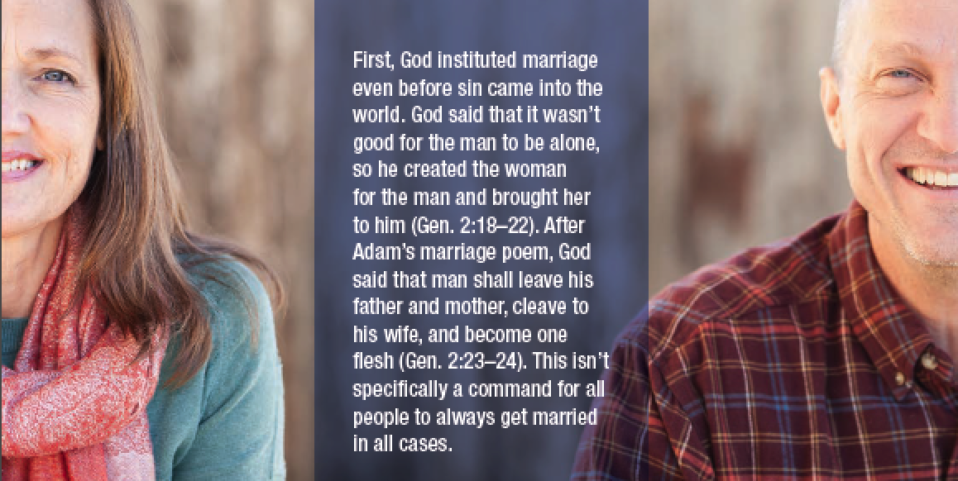
First, God instituted marriage even before sin came into the world. God said that it wasn’t good for the man to be alone, so he created the woman for the man and brought her to him (Gen. 2:18–22). After Adam’s marriage poem, God said that man shall leave his father and mother, cleave to his wife, and become one flesh (Gen. 2:23– 24). This isn’t specifically a command for all people to always get married in all cases. However, it is God’s ordinary plan for how people in his world exist together: men and women will leave their parents’ domain, get married, and become one flesh. Even before the Fall, marriage was for companionship. The same is true even after the Fall. For one example, the love story in the Song of Solomon includes a strong bond of friendship (cf. Song 4:10; 5:16b).
The second reason why Christians are to ordinarily get married is found in the general flow of Scripture. What I mean by this is that in the Bible stories, God’s people typically marry. After the creation mandate for a husband to leave his parents and cling to his wife one ordinarily finds God’s people getting married and having children. From Adam and Eve to Noah and his wife to Abraham and Sarah, marriage and family is the ordinary way of life for God’s people in history. Two commandments address the family situation: honor your father and mother and do not commit adultery (Ex. 20:12, 14). Genealogies are family records in Scripture. The covenant of grace has to do with believers and their children (e.g., Gen. 17:7; Acts 2:39). It’s impossible to summarize the emphasis that the Bible puts on families in one paragraph, but suffice it to say that typically in the Bible God’s people marry and have children.
Another aspect of the Bible’s emphasis on marriage is the frequent commands to husbands, wives, parents, and children. I have already noted the fifth and seventh commandments. Proverbs says much about marriage and family. A man is to rejoice in the wife of his youth (Prov. 5:18). In fact, the man who “finds a wife finds a good thing and obtains favor from the Lord” (Prov. 18:22). Jesus spoke highly of marriage when he quoted Genesis 2:24 (Matt. 19:5–6). He also blessed children when they came to him (Mark 10:16). Paul repeatedly addressed the Christian family in his letters. Children are to obey their parents (Eph. 6:1; Col. 3:20). Husbands and wives are to love and respect one another (Eph. 5:22– 33). One might even argue that “gift” in 1 Corinthians 7:7 refers not just to singleness, but to marriage as well. In fact, Paul said marriage is a mystery that is a sort of picture of the gospel: Christ’s self-giving love for his church (Eph. 5:32).
The third biblical reason that Christians should ordinarily get married is found in Paul’s instructions on singleness and marriage in 1 Corinthians 7. As noted above, Paul did say that singleness was a valid option for believers (1 Cor. 7.6–8). However, he also wrote that “it is better to marry than burn with passion” (1 Cor. 7:9). “Passion” in this context is a strong sexual desire. In other words, it is not good for a Christian man or woman to burn with sexual passion and continue to remain unmarried. Paul said it like this: “because of the temptation to sexual immorality, each man should have his own wife and each woman her own husband” (1 Cor. 7:2). Singles and widows who do not have self-control in the area of sexual purity are to get married (1 Cor. 7:9a). If an unmarried Christian man or woman has stronger sexual desires and urges, it is a big hint that God’s will for him or her is to marry. To be sure, marriage is not only or primarily for the satisfying of sexual desires. It is for “preventing of uncleanness,” as the Westminster Confession says, but marriage is also for companionship, the “mutual help of husband and wife” (WCF 24.2).
John Calvin commented on 1 Corinthians 7:6–8 like this: “First, [Paul] means that the greater part of men [people] are subject to the vice of incontinence [lack of sexual restraint]; secondly, of those who are so subject he enjoins all without exception to take refuge in that sole remedy with which to resist unchastity.”2 In other words, “the companionship of marriage has been ordained as a necessary remedy to keep us from plunging into unbridled lust.”3 Because most people do have a stronger sexual drive and desire for close companionship, a man should marry a woman and a woman should marry a man. Biblically, for the single Christian, one major way to “flee” sexual immorality (1 Cor. 6:18) is to have a husband or wife. In this way a person’s sexual desire can be fulfilled legitimately, and he or she can enjoy the blessing of companionship.
Calvin even said that those who have strong sexual passions and refuse to get married “are striving against God and resisting his ordinance.”4 Calvin’s blunt words should not be understood as if marriage is a cure-all for sexual sin and lust. Married people also struggle with sexual sin and lust! Although marriage is not the only help in our aim for purity, it is one of the great helps God has given us to assist us in remaining sexually pure.
Practical Matters
Should the Christian get married? The ordinary answer to that question from a biblical perspective is yes. God does call some Christians to either temporary or permanent celibacy. However, ordinarily Christians should get married. As we learned, marriage is an ordinance of God that he instituted even before the Fall. In Scripture, most of the stories are about God’s people who are married. The Bible gives many instructions for husbands, wives, and families. Finally, Paul clearly tells unmarried Christians who have a strong sexual drive that they are to get married. Those are biblical realities to think about when answering the question: Should the Christian get married?
I realize I’ve only scratched the surface of a much larger discussion. My goal is to provide some basic biblical guidance in the area of singleness and marriage. For the Christian whom God has gifted with celibacy and a sexual drive that is not so strong: bless you! I realize your Christian life might not always be easy, but your calling is a high one. Stay pure and strong in the Lord, keep living for him, and be a blessing to many people. And for you single Christians who do have a stronger sexual drive and desire for companionship: stay pure! If you’ve stumbled, remember there is forgiveness and healing in Christ. Pray for a godly spouse. Get out and look in Christian places for a Christian spouse. Trust me, there are other Christians looking for a godly spouse. Don’t despise marriage but consider it a blessing and gift to help you in the area of companionship and a help in your quest for sexual purity. And to conclude, it’s good to remember that whether married or single, young or old, rich or poor, we are all one family in Christ (Gal. 3:28; Eph. 2:19).
1. Gerald Bray, God Is Love: A Biblical and Systematic Theolog y (Wheaton, IL: Crossway, 2012), 319 2. John Calvin, Institutes of the Christian Religion, edited by John T. McNeill, translated by Ford Lewis Battles, vol. 1, The Library of Christian Classics (Louisville, KY: Westminster John Knox Press, 2011), II.viii.43. 3. Calvin, Institutes, II.viii.41. 4. Calvin, Institutes, II.viii.42.Shane Lems is the pastor of Covenant Presbyterian Church in Hammond, WI.