


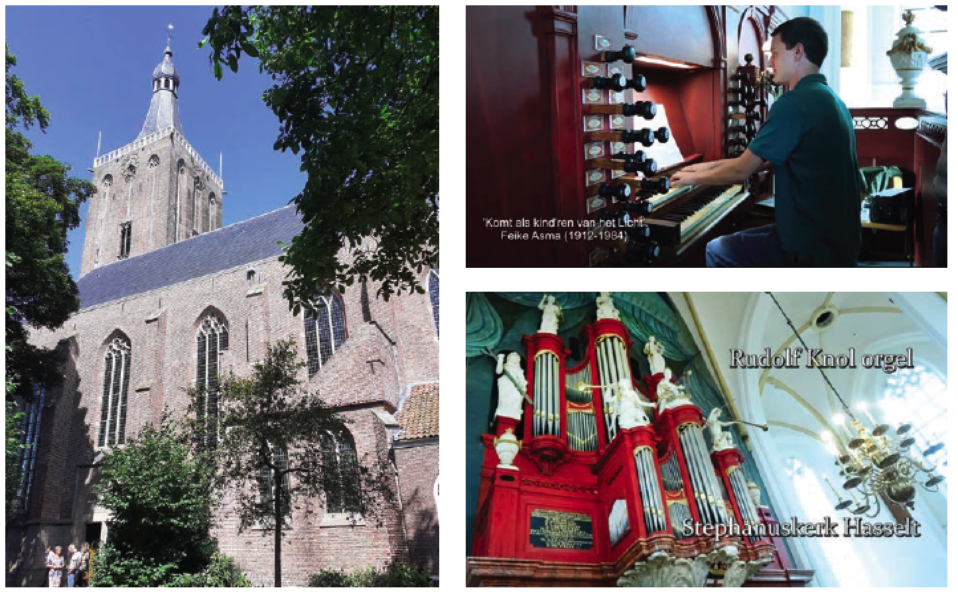
The Dutch organist Feike Asma (1912–1984) was renowned in Reformed circles for his unique style and his ability to improvise on familiar psalm and hymn tunes with incredible variety. No two of his performances of a song were identical. However, some of Asma’s best- known renditions were eventually transcribed by other musicians and became available as sheet music. This format marked my introduction to a Dutch hymn I knew as Komt als kind’ren van het licht. While visiting the Netherlands last summer, I recorded Asma’s arrangement on the famous Rudolf Knol organ (c. 1804) in the Stephanuskerk in Hasselt.
I’ll describe the music of this hymn before describing the text. The arrangement opens with churning eighth notes that increase in pitch and intensity, never ceasing until the final chorale. The melody is simple and bright, easy to learn and fun to sing. As to the origins of the tune, my research so far has turned up nothing. The music sounds like a typical seventeenth- or eighteenth- century Dutch or German chorale, but I have not yet been able to identify its composer—nor even to find other hymns with which it has been used.
I gave up on identifying the source of the music and turned my attention to the text instead. This, too, was a mystery; the edition of Asma’s organ arrangement described the piece as a “Lutheran song” but did not give its origins. Could it have been authored by Luther himself? Here I was grateful to receive research help from Dr. Jaco van der Knijff of the Theological University of Apeldoorn. Apparently, the text that begins “Komt als kind’ren van het licht” (“Come, as children of the light”) serves as the second stanza of a longer hymn. That hymn appeared in an 1886 Dutch hymnal entitled Godsdienstige liederen (“Religious Songs”). The text is by J. A. Böhringer, a Lutheran minister— so the description of a “Lutheran song” refers to the denomination of its author rather than to Luther personally.
As I worked on an English translation of the full text of this hymn, I noticed a tone very different from the Dutch compositions I have so far encountered. This text is insistent, strident, and poetically choppy—analogous to the incessant eighth notes of Asma’s music. The first line of the opening stanza refers positively to “work unceasing” (literally, “restless work early and late”), urging Christians onward in their service. The second and third stanzas exhort them to walk as “children of the light,” fearless in the face of adversity. The fourth stanza describes the motivating power of faith, and the fifth issues a final command punctuated by an ominous afterword: “Work today . . . because our night/Soon will have its hour.” This poses quite a contrast to texts like Alle roem is uitgesloten, in which the center of the Christian life is peace and rest in the finished work of Jesus.
I was not alone in these observations. Apparently my query to Dr. Van der Knijff sparked his own interest in this hymn, for shortly after our email exchange he published an opinion piece in the Reformatorisch Dagblad (the Netherlands’ main conservative Reformed newspaper) with the title, “Organ Playing: A Safe Hobby?”1 The article presented concerns about the origin and themes of Komt als kind’ren, especially since the hymn gained its popularity from liberal songbooks of the early twentieth century. Dr. Van der Knijff reflected on the irony that Asma’s organ music, so popular in conservative Reformed circles up to the present day, served as a conduit for theological liberalism. A YouTube subscriber from the Netherlands expressed similar concerns about the arrangement in an email to me.
The complexity of the story surrounding Komt als kind’ren raised larger questions in my own mind. Is the text too saturated with optimism and humanism to be “safe” for Reformed Christians to sing? And what other hymns have we accepted as part of our ecclesiastical heritage without ever pondering their origins or the content of their doctrine? For example, the beloved old hymn “Faith of Our Fathers” was written by a former Episcopalian priest after he converted to Roman Catholicism.2 Perhaps that fact alone ruins the message of the song. Perhaps it does not. In any case, our hymnals and song sheets deserve careful scrutiny, and the task of choosing music for Christian worship comes with sober responsibility.
In this case, I am inclined to think that the message of Komt als kind’ren can still fit within a thoroughly Reformed understanding of faith and life under the category of Christian service, the third section of the Heidelberg Catechism. I believe it can be sung wisely and appropriately as long as the once-for-all sacrifice of Christ is contextually present. But I’ve presented the full text of Komt als kind’ren here so that readers can judge for themselves. What do you think? By what standards should we judge what music is “safe” to sing in church? And what can this fascinating exemplar from Dutch hymnody teach us about the relationship between music and doctrine?
To hear the hymn, go to <https:// youtu.be/-PUsCRaqK8U>.
1. Jaco van der Knijff, “Column: Orgelspelen een veilige hobby?,” Reformatorisch Dagblad, December 20, 2021, https://www.rd.nl/ artikel/955733-column-orgelspelen-een- veilige-hobby.
2. “Frederick William Faber,” Hymnary.org, https://hymnary.org/person/Faber_Frederick.
Michael R. Kearney is a board member of Reformed Fellowship. He is pursuing a Ph.D. in Rhetoric at Duquesne University in Pittsburgh.