


Do you have a favorite psalm? The Psalms have been my favorite book of the Bible for as long as I can remember. When I was growing up, each New Year my family would make a list of goals to accomplish in the coming year. I remember writing, “Read a book on the Psalms,” and my family responded that I should broaden my horizons. Perhaps you have also spent many years reading and enjoying the Psalms. I hope you have memorized some of them and are in the habit of coming back to them when you need help, comfort, and strength. Even if you are fairly new to the Psalms, here are some ideas that may help you as you go through this portion of God’s Word.1
Pay Attention to the Middle
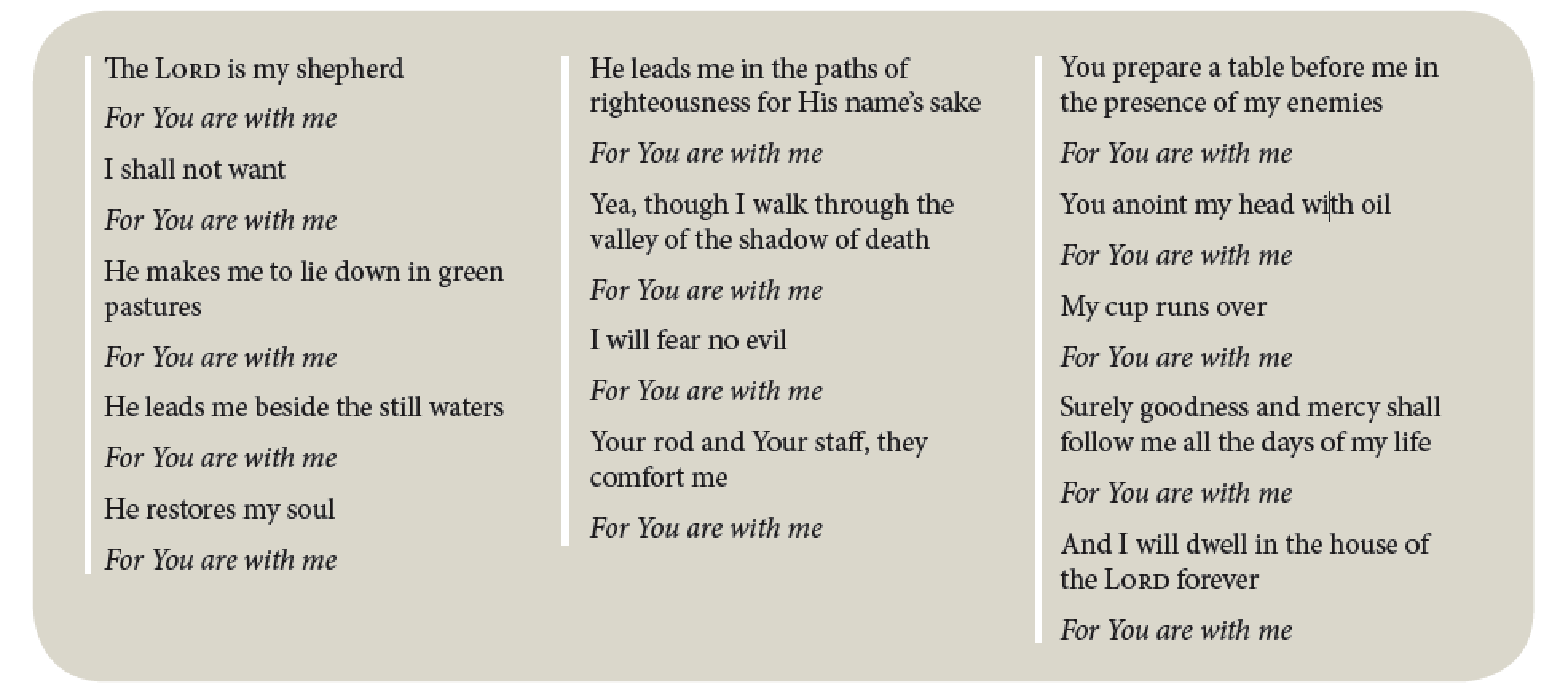
We know that the Psalms are poetry; it is important to note that in Hebrew poetry, the middle part of the poem is often the main point or climax of the poem. In fact, the middle part of the psalm can be such a strong point that it clarifies and expands each verse in the psalm. The middle verse of Psalm 23 is verse 4, “For You are with me” Try reading Psalm 23 like this:
Read the Psalms in Context
We tend to read most books of the Bible from start to finish, beginning with chapter 1 and ending with chapter _ (whatever it ends with). Why don’t we do that with the Psalms? Surely God inspired not only the content but also the order of the Psalms. If you are interested in Psalm 20, at least read both Psalms 19 and 21 as you study it. Reading large chunks of the Psalms in one sitting can give you a big picture of themes and helps to inform your understanding of one particular psalm. For example, recently we were studying Psalm 18 in Bible study, so I looked at Psalms 5 through 18. It was fascinating that Psalms 5 through 17 each have the theme of conflict and enemies, and then Psalm 18 is a victory psalm celebrating God’s faithfulness in conquering David’s enemies. Without the conflict of the previous psalms, the victory seems a little flat.

Use the Psalms to Meditate
The Psalms are songs and meditations, so they are the perfect springboard for meditating on God’s truths. For example, in Psalm 139, the main theme is how God searches us and knows us completely. Verse 7 asks, “Where can I go from Your Spirit? Or where can I flee from Your presence?” This rhetorical question prompts the obvious answer: “Nowhere!” However, the psalmist doesn’t stop there but keeps on asking. He asks us to ponder, think, and meditate on this wonderful truth, with six additional places mentioned where God sees us: heaven, hell, the wings of the morning, the uttermost parts of the sea, darkness, and light.
Look for Jesus
One of the easiest and most overlooked ways to look for Jesus in the Psalms is with the simple word “Selah.” We aren’t sure exactly what it means, but a Reformed pastor says that every time we read the word “Selah,” we should see how it points to Christ. A great example of this dynamic is Psalm 3. In Psalm 3:2 we read, “Many are they who say of me, ‘There is no help for him in God.’ Selah.” This verse should remind us of Matthew 27 when Jesus was hanging on the cross and the crowds mocked him, saying, “He trusted in God; let Him deliver Him now if He will have Him” (v. 43). Going back to Psalm 3:4, we read, “I cried to the Lord with my voice, and He heard me from His holy hill. Selah.” Surely, if anyone was ever heard by the Lord, it was his only begotten Son, Jesus. Psalm 3 ends: “Salvation belongs to the Lord. Your blessing is upon Your people. Selah” (v. 8). And the only way that God’s blessing can be upon his people is through the sacrifice of Jesus on the cross. Reading the Psalms with Jesus in mind will help you to more fully appreciate who he is and what he has done for you.
Allow Your Union with Christ to Help You Understand the Psalms
For the modern reader, the Psalms can seem like a venture into a dark and distant past. A friend of mine commented, “The whole first part of Psalms is brutality and war. I was not expecting that—it was not comforting at all.” The point of the Psalms is not that David had all these enemies and problems and so we should identify with him somehow and be happy that he was rescued. Instead, we should see David, the king of Israel, as being a type of Christ, the only true King. Jesus Christ also endured much suffering and brutality, and was even abandoned by God. He is the main one that the Psalms are talking about. When we become Christians, we are united to him by faith. Through this union with Christ, we can see our own sufferings in light of his sufferings. We can see that, although we are not surrounded by enemy armies, we have many enemies in our lives that try to keep us from following God.
Do you have a favorite psalm? Is there a concept that has helped you in your understanding of the Psalms? And do you have a recommendation for a book on the Psalms? If so, please feel free to e-mail me (potatogunsister@gmail.com) and let me know. I’m still studying the Psalms, and I’ll need a good plan for my next New Year’s resolution.
1. Some of the following ideas are drawn from Dr. Robert Godfrey, Learning to Love the Psalms (Sanford, FL: Reformation Trust, 2017). The Scripture translation used in this article is the New King James Version.
Vanessa Le is a wife and mom to four children age six and under. She enjoys reading, playing the piano, studying theology, and generally being Mommy. She is a member of Orlando Reformed Presbyterian Church in Orlando, FL.