


In the 2022 January/February issue of The Outlook, I introduced readers to the sixteenth-century Genevan Psalter, one of the earliest and best-known of the many metrical psalters produced over the past nearly five hundred years. In that article, I discussed its origins in Strasbourg and Geneva, its debt to the much earlier patterns of daily prayer originating under the old covenant, and its subsequent translation and use in many countries where Reformed Christianity was present. In this article, I will discuss my own project to set the 150 Psalms to contemporary English verse according to the Genevan tunes.
My initial contact with the Genevan Psalms came during my childhood at Bethel Orthodox Presbyterian Church in Wheaton, Illinois, a congregation my parents had started with another family in the late 1950s. While most of the psalms in the 1961 Trinity Hymnal from which we sang were from the influential 1912 Psalter, a few used the Genevan tunes of Louis Bourgeois, the first entry being the ubiquitous “All People That on Earth Do Dwell,” William Kethe’s versification of Psalm 100 set to the Genevan tune for Psalm 134. I cannot say that these made much of an impact on me at the time, largely because the psalm texts were interspersed among the other hymns in this unusually large collection. If we had been singing psalms, I was not aware of it. After we began attending a Baptist church when I was eleven, psalm singing all but disappeared for our family.
My second contact came at age twenty-one, when, during a memorable visit to Prague with a student group, I purchased a Czech-language psalter and hymnal containing Jiří Strejc’s versifications mentioned in my previous article. At that time, the communists were still ruling the country, although remnants of the earlier Habsburg era were everywhere to be seen, including ancient volumes in antiquarian bookstores. A decade later, I was startled to recognize that this volume contained the complete Genevan Psalter, along with a host of hymns of mostly Reformation German origins. It was published in 1900, and its original owner may later have gone through the horrors of the Great War, which would dismember Austria-Hungary and create a new and vulnerable landlocked state in the middle of Europe.
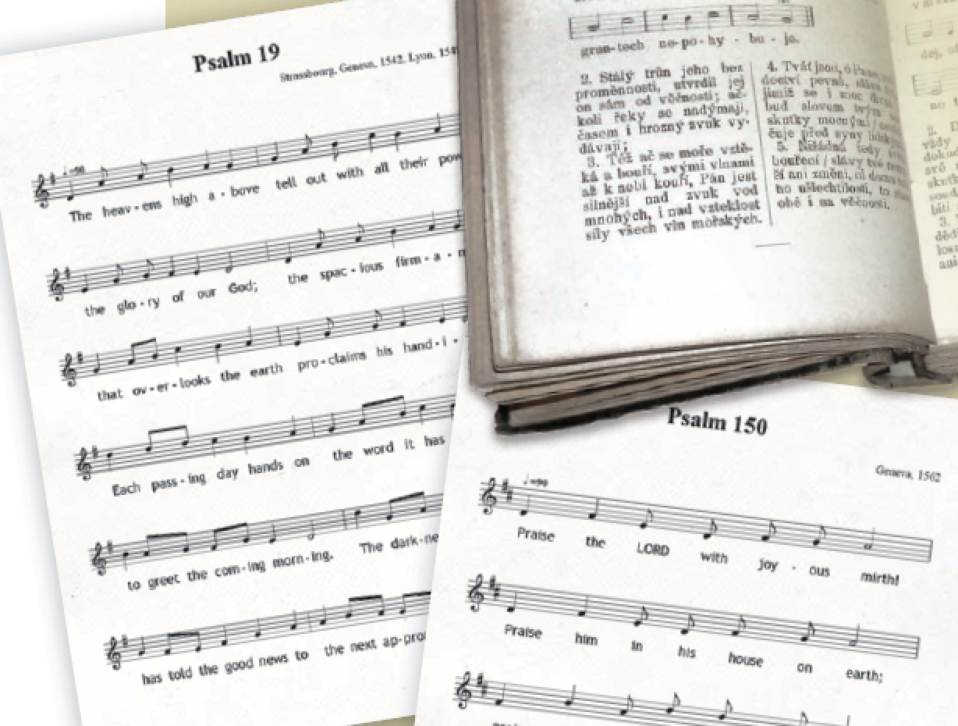
Then in 1985 I was visiting Toronto. A friend I had known from my previous studies there alerted me to the recently published Canadian Reformed Book of Praise, containing the Genevan Psalms in English. On returning to South Bend, Indiana, where I was then a graduate student, I ordered a copy. I found it an impressive collection in many ways, although it struck me that the versifications therein showed, among other things, the limitations of the original rhyming schemes, in which the stresses in the music and those in the text do not necessarily match. An example from the French will suffice to illustrate. Here is the first stanza of Psalm 13:
Jusques à quand as establi,
Seigneur de me mettre en oubli?
Est-ce à jamais? par combien d’aage
Destourneras-tu ton visage
De moy, las, d’angoisse rempli?
Note that the rhyming scheme is A-A-B-B-A. However, the alternation of masculine (stressed) and feminine (unstressed) endings in the tune does not quite match this scheme: M-F- F-M-F. Hence the French verse fails to flow in the way one might expect, which makes for somewhat awkward singing. This same defect has found its way into all the translations of the Psalms of which I am aware, due to a somewhat slavish fidelity to the original rhyming schemes.
Around the same time, I came into possession of a vinyl recording of Hungarian Psalms sung by the Debrecen College Cantus, a choir associated with Debrecen Reformed College in Hungary, an institution founded in 1538, only twenty-one years after Luther had launched the Reformation. I was immediately taken with what I heard, especially the Cantus’s performances of Psalms 23 and 121, which I found particularly moving. Thus began a near obsession with the Genevan Psalms with which I have been (probably terminally) afflicted for most of my life.
As a result of these experiences, I decided to set to verse several psalms according to their proper Genevan melodies. It was 1985, and I was near the end of my graduate education at the University of Notre Dame. As a member of the South Bend Christian Reformed Church, now Church of the Savior, I sang a few of these as solos, with the organist using the 1940s arrangements of Jacques Pierre Bekkers and Jacob Kort. One of these was Psalm 46, which I sang for a combined Reformation Day evening service with a Reformed Church in America congregation in nearby Niles, Michigan:
God is our refuge and salvation,
Our present help in tribulation.
We will not fear though earth may shake,
For God will keep us mid the quake.
Mountains may fall into the ocean,
But we will not fear such commotion.
With us the Lord of Hosts shall dwell,
The mighty God of Israel.
I set other psalms to verse as well, beginning with numbers 12, 47, and 91 in 1985, and then 1, 5, 6, 8, and many others making a total of forty-one versifications as of 1988. By then I was teaching political science at Redeemer University College near Hamilton, Ontario, where new course preparations took up most of my time, leaving little to devote to my ongoing psalter project. Yet by this time I was hooked, and as I settled into my routine of teaching, research, and writing, I found the occasional moment to devote to setting yet another psalm to verse.
By the end of the century, I had set to verse sixty-five, with ten more coming fairly quickly during a bout with depression in 2006. My work took a long pause around 2014 as I struggled unsuccessfully to retain my job in the midst of budget cuts and layoffs.
Throughout this time, I was also arranging a sizeable number of the Genevan tunes, working them out first on guitar and then with music notation software. Some of these can be found on my YouTube channel. (Type my name into the YouTube search box to locate it.)
Following my retirement, I found more time to devote to this project. In 2021 The Priscilla and Stanford Reid Trust awarded me a grant to continue my work on it. I proposed a goal of setting thirty psalms to verse over the succeeding months. At the beginning of June, I began working steadily through the Psalms, putting aside for the time being my efforts to arrange the tunes. Up to that point I had set to verse eighty- six psalms, scattered throughout the canonical collection. I decided to begin with Psalm 3, as I had already done the first two, and take them in order. I kept a one-volume psalter, given by a close friend, before me at all times. I pulled up an online resource called Bible Hub, which allowed me to compare multiple English translations verse by verse. I input the proper tune into my music notation software, rewording each line to fit the appropriate metre. This more systematic method enabled me to work through the remainder of the Psalms at a faster pace than I had anticipated. Thus, by the middle of August, I had completed the remaining unfinished psalms, most of them unrhymed, at last reaching 150, thereby exceeding the target I had set for myself in the Reid Trust proposal.
Here is my own versification of Psalm 13, which departs from the traditional rhyme scheme, using instead A-B-B-A-C, which in my judgement better corresponds to the metrical structure of the music and eliminates the unnecessary melisma (that is, multiple notes sung to one syllable) in the fourth line:
How long, O Lord, must I endure?
Will you forget me for ever?
Shall I look on your visage never?
How long shall my soul constant pain endure,
and my poor heart be in sorrow?
Shall my foes have the victory?
Answer me, Lord; hear my pleading!
Lighten my eyes—my voice be heeding—
lest mortal sleep should overpower me,
and enemies think me vanquished.
Though my foes sneer at my distress,
yet your love is my foundation.
My heart is glad at your salvation.
I raise my song the faithful Lord to bless,
for he has treated me kindly.
Suffice it to say that this project, which takes me well outside my field of professional competence, has been for me a genuine labor of love—of love for the Psalms and for the God who inspired their writers. Athanasius wrote of the Psalms that they are a kind of compendium of the whole of Scripture. As each book of the Bible is like a garden bearing its own unique fruit, the Psalms bear all the fruit found in the other books. Calvin famously labeled the Psalter “‘An Anatomy of all the Parts of the Soul;’ for there is not an emotion of which any one can be conscious that is not here represented as in a mirror.” As I seek a publisher for my collection, I hope and pray that it may help the larger church to recover the liturgical use of the Psalms, especially in those traditions where they long ago fell out of use. After all, the Psalms are simultaneously the most confessionally Reformed and the most ecumenical worship resource we have. First, the Genevan Psalms are the common heritage of the Reformed churches. Second, the Psalms themselves we share with our fellow Christians of virtually every tradition. And third, the Psalms we have in common with observant Jews, even if we interpret differently especially the messianic psalms.
In closing, I offer my versification of Psalm 150, the magnificent grand finale to the Psalter:
Praise the Lord with joyous mirth!
Praise him in his house on earth;
praise him in the heav’nly height.
Praise him for his acts of might.
Alleluia! alleluia!
Praise his all-surpassing grace.
Bow and sing before his face:
Alleluia! Alleluia!
Praise God with the trumpet sound,
harp and lute, his praise resound.
Play the timbrel; dance his praise.
Strings and flute, extol his ways.
Alleluia! alleluia!
Clashing cymbals, praise the Lord;
all that breathe, with one accord
praise the Lord! Sing alleluia!
David T. Koyzis is a Global Scholar with Global Scholars Canada and the author of Political Visions and Illusions (2019) and We Answer to Another: Authority, Office, and the Image of God[ (2014). Anyone interested in publishing his complete Genevan Psalter collection should contact him at dtkoyzis@gmail.com.