


On January 22, 1973, the U.S. Supreme Court made the infamous decision which made abortion–on-demand a legal national policy. On the basis of several grounds this policy has been judged to be wrong. Putting aside al l other considerations, what can we say, from a biological point of view, about human life before birth that will help to understand the issues more clearly?
That babies are well-formed later in pregnancy is well known to everyone. We know that, when babies are born prematurely, all the body parts are there and function well, so that many “premies” survive and proceed to live productive lives. Obviously, neither prematurely born babies nor full term babies suddenly form the day before birth.
But what do we know about the earlier stages of human development, during the first few weeks of life? Is the embryo or fetus then only a “blob of tissue” as some have claimed? Let us take a look at the very beginning.
F.R. Lillie says in his book Problems of Fertili zation :
“. . . The elements that unite [i.e., the sperm and eggAM] are single cells, each on the point of death; but by their union a rejuvenated individual is formed which constitutes a I ink in the ‘eternal’ process of life.”1
What a thought, that from the seemingly hopeless destinies of two cells a new entity forms, with a new, dynamic future! This is the beginning of a new individual.
Through cell division this one cell gives rise to more and more cells, not just to form a homogeneous mass, but to grow gradually into the very specialized structures which make up a new baby.
About three to four days after fertilization a number of special features are already visible, and soon definite germ layers are established from which organs are formed. For example, at 18 days, when the embryo is about 1.5 mm long, the neural plate is already present which gives rise to such organs as the brain and the eye. And at 21 days the heart is formed and is pumping blood through well-formed blood vessels, circulating it all around. And then, in the fourth week we see not only the heart beating, but the eyes and ears begin to develop; arm and leg buds appear; and the embryo grows up to 4 mm in length (which is only as long as the thickness of four dimes stacked on top of each other). This new individual is quite tiny at this time, yet it shows strikingly clear structures, even before the first month of development has been completed.
Our conclusion on the basis of these facts must be that the embryo is indeed a highly structured individual, right from the beginning.
As time goes on, more organs form . When at the end of two months all organs are present, the embryo is called the fetus. Even individual fingers and toes are present at this time. And elements of the vertebral column are beginning to form.2 The only thing that still has to happen is that these organs have to grow bigger and learn to do what they are supposed to do. Muscles must be strengthened, specific nerve connections must be made, etc.
It goes without saying, therefore, that at no time can we say that the embryo or fetus is “only a blob of tissue.” Anyone who would maintain this, whether a doctor or a lay person, is ignorant of the facts. We are definitely and incontrovertably dealing with a new human individual with very definite human features.
This new human life is a precious gift from God. He is the Creator. And in God’s Word we read very clearly that human life is sacred. We may not take it or disrupt its development, either before or after birth.
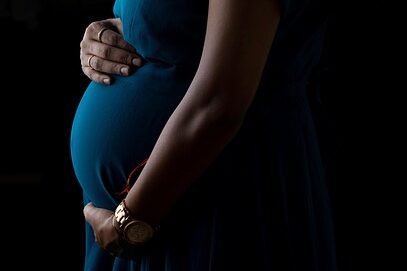
A question which often comes up asks, “When does human life begin?” In other words, when does this “thing” become a human life? Clearly we are dealing with human life right from the start. First of all, it is human because it could not possibly be a kangaroo, a robin, a frog or anything else. It could only be human. Its DNA, inherited from human parents, can spell out the development of only human offspring. All the information is present from the time of fertilization. And secondly, it is life, because it is living. If it were not living no one would have to worry about getting rid of it, since it would then abort spontaneously anyway.
Another question asks whether the mother has a right to her own body. And the answer is that, of course, she has the right to her body. But she does not have the right to do to the body of her baby as she pleases. The embryo or fetus is not part of her body, even though it grows inside her womb. Of course, she had the right to decide whether or not to conceive. But once conception has occurred she may no longer choose not to be pregnant.
However, what can a mother do when she finds that she is pregnant but really does not want to have the baby? First of all, she ought to carry the baby to full term. This is better for her own bodily and mental health. She is less likely to have health problems or to develop severe psychological scars. And it has the obvious benefit that the baby will be allowed to live.
Secondly, and very importantly, there are a number of people who are willing to help the mother, both during and after pregnancy.
For example, there is Birthright , which is a group of people whose creed is that 1) every mother has the right to give birth; and 2) every baby has the right to be born. This Birthright organization offers a viable alternative to abortion by encouraging the mother to bear the baby, and by helping to find financial and medical help to do so.
Anyone interested in the services of Birthright can find the address and telephone number in the telephone directory. Usually collect calls are accepted by them.
This group of people is a private, independent organization of volunteers. They keep no records, and their services are strictly confidential.
The best alternative to abortion is, of course, adoption. There are many families who would gladly adopt a baby, and give it a good home and lots of love. It is also reassuring that Christian adoption agencies make it a real point to place the baby into the kind of family that the mother specifies. We know that adopted children bring much happiness and joy to a home. And for the mother it is a great comfort to know that her baby is adopted into a good family. This can give her real peace, and avoid those gnawing guilt feelings which abortion often brings.
Human life is precious , not only before birth, but also after birth, all the way through old age. Whether an infant is normal, or abnormal in some way, the life of the child is precious. And when people get old and do not contribute extensively to the activities of the community any more, their life, too, is still precious. They still have a lot to give to those with whom they associate. They can be a real blessing when given a chance to share with us the wisdom they have gathered over the years. Let us, therefore, respect life, from beginning to end.
1. Lilly, F. R., 1919. Problems of Fertilization. University of Chicago Press, Chicago.
2. Moore, K. L. 1977. The Developing Human. Saunders, Philadelphia. Dr. Aaldert Mennega is a Professor of Biology at Dordt College, Sioux Center, Iowa.