


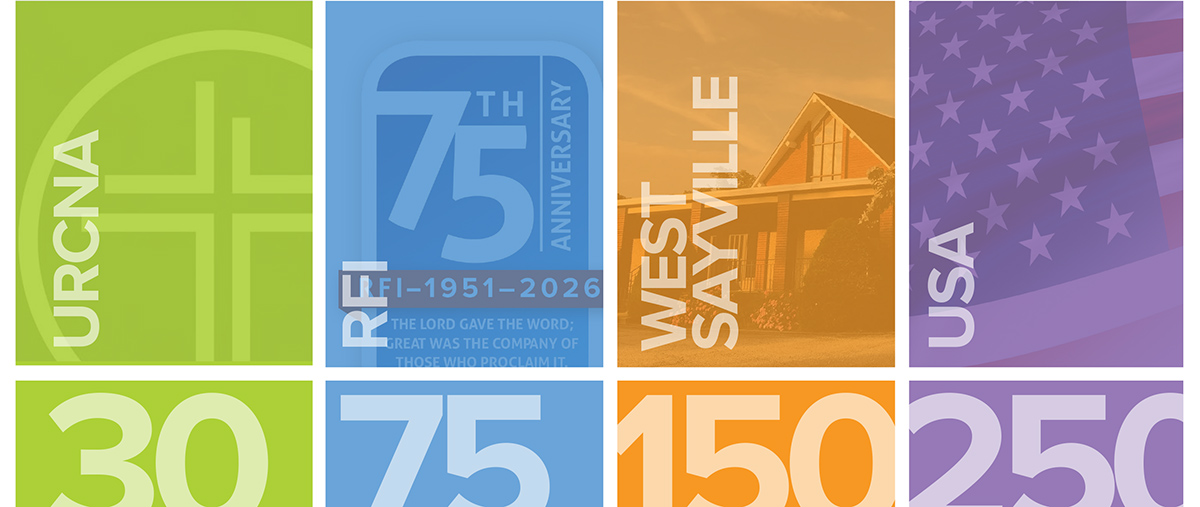
We are entering a year of milestones: the 30th anniversary of the United Reformed Churches in North America (URCNA)1, the 75th anniversary of Reformed Fellowship, and the 150th anniversary of the congregation I grew up in, West Sayville Reformed Bible Church—not to mention the 250th anniversary of the United States of America.
The church in West Sayville has some connection to each of the other anniversaries as well. Founded as a mission work of the Christian Reformed Church (CRC) in 1876, that congregation has affiliated with the URCNA since 1998. Located on the south shore of Long Island, about fifty miles east of New York City, the congregation followed the history of waves of European immigration to America in the late 1800s and early 1900s and the rapid demographic transformation of the East Coast in the last several decades. The church has shifted from serving the families of a small community of Dutch fishermen to being a waystation for all kinds of people in various walks of life who are seeking answers to life’s questions from God’s Word in the fellowship of believers.2
An Old Church in a Young Federation
The West Sayville congregation was not technically a charter member of the URCNA, although its leaders and concerned members participated in many of the conversations that led to the creation of our federation of churches. Nonetheless, I believe the West Sayville church is the oldest congregation in the URCNA—that is, the oldest local body to join the federation intact, without a church split, while maintaining its legal and ecclesiastical identity. Many other congregations, from brand-new plants to churches with more than a century of history, have thrown in their lot with this fledgling group of churches that now turns thirty this year.
The conversations that led to the formation of the URCNA, in turn, are closely tied to the history of Reformed Fellowship. Now and then the discussion comes up in a board meeting or conversation with a Reformed Fellowship supporter: is Reformed Fellowship a URCNA entity? Many of our members attend URCNA churches; several of our board members are URCNA ministers. Multiple United Reformed congregations in West Michigan have offered us the use of their facilities for events and storage. We publish works by numerous United Reformed authors, we distribute the Life in Christ catechism series used across the URCNA, and we print the official URCNA membership directory each year. Reformed Fellowship seems to be as official of an unofficial publishing house of the URCNA as you could get.
And yet we are also not. In principle, Reformed Fellowship and The Outlook have always been open to all individuals and churches who adhere to the Reformed faith as expressed in the Three Forms of Unity or the Westminster Standards. We actively try to recruit board members from multiple Reformed denominations and to be present at a variety of Reformed and Presbyterian events. If you ask anyone involved in the leadership of Reformed Fellowship, I think you will get a consistent answer: Reformed Fellowship is not meant to be exclusively or even predominantly centered on the URCNA.
As URCNA officebearers and members think about the opportunities that lie ahead of our federation in the next thirty years (and that is what I am envisioning in this series of articles, a kind of prospectus of some of the unique opportunities that confront us), the relationship between the URCNA and Reformed Fellowship deserves a little more historical explanation. One exchange that occurred on the pages of this very magazine in 1977 and 1978, in particular, helps us understand the directions and relationship of the two institutions today.
Let me set the context. Rev. John Vander Ploeg had taken up editorship of The Outlook after editing The Banner, the official periodical of the CRC, from 1956 to 1970. He was a well-respected minister with an established audience, and he used the platform of Reformed Fellowship’s magazine to launch a wide-ranging critique of departures from Reformed orthodoxy in the CRC.
Vander Ploeg changed the magazine’s title from Torch and Trumpet to its present name.3 He saw the mission of the magazine as just that: providing an outlook, a direction—a proactive voice rather than just a reactive one. Vander Ploeg’s editorship was marked by an activist spirit and a sense of urgency, eliciting many notes of support as well as critique from readers. In an age without the internet and social media, members of the Reformed community spread across the United States and Canada engaged in fellowship and debate largely on the pages of this magazine.
An Agenda-Setting Editorial
Vander Ploeg’s July 1977 editorial was titled “Desideratum—A United Reformed Church.”4 This was not only the first time a term as arcane as “desideratum” appeared in The Outlook; it was also, to my knowledge, the first published use of the phrase “United Reformed Church” to describe a vision of a confessionally Reformed union of congregations in North America. That vision, again, was both reactive and proactive: if a union of congregations would “purge themselves of the foe within the gate and of those bold innovations that now threaten to undermine the Reformed faith,” Vander Ploeg contended, the result would be a new “denomination that would not shilly-shally in its witness to the Reformed faith but a church that would rather be unambiguous, consistent, and enthusiastic in the profession of it.” While the CRC was the primary harborer of the “foe within the gate” in Vander Ploeg’s estimation, his vision of a new denomination extended to all Reformed churches that desired to make sola Scriptura the central principle of their unity.
Vander Ploeg voiced the sentiment of many conservative Christian Reformed members who objected to liberalizing developments in their denomination, but his proposal was a call for educated collective action, not just grandstanding. First, church leaders as well as laypeople needed to read, investigate, and examine the issues confronting their denomination. Second, The Outlook needed to offer a forum where “contributions from our readers as to how to bring into being a truly United Reformed Church are welcome.” Third, members of the CRC and other people of Reformed convictions ought to consider organizing local chapters of Reformed Fellowship. The goal was to help a concerned group of members find a sense of direction.
Vander Ploeg wanted responses, and he got them. An anonymous reader from Florida wrote to agree with Vander Ploeg’s basic proposal but to offer a different name: the Orthodox Christian Reformed Church. “Why should we lose our precious name?” he demanded. “After all, we are not leaving the church—the church is leaving us.” Interestingly, the same reader also predicted, “No doubt THE OUTLOOK will be the new church paper.”5 Another reader pointed out that, since 1972, there already was a (liberal) denomination named the United Reformed Church in the United Kingdom. A Protestant Reformed contributor to The Standard Bearer commended Vander Ploeg for raising the alarm but claimed that any new denomination would need to revisit the CRC’s 1924 decision about common grace.6 A writer for the Canadian Reformed paper Clarion supported the editorial but stated that secession must be pursued in and through seeking unity with other likeminded denominations.7
Others were not as enthusiastic. Rev. Jelle Tuininga offered a stern response: while he shared Vander Ploeg’s desire to return the CRC to its confessional heritage, he believed that planning a secession, as opposed to being forced into a secession, was arguably schismatic. Moreover, he found the vision of a confessional group of Reformed churches “unduly idealistic and unduly illusory.”8 Tuininga’s response got its own counter from Donald Blaauw in Holland, Michigan. Blaauw stood behind Vander Ploeg all the way: “We ought to thank our God again and again for the spiritual idealism and the courageous foresight (illusions?) of our forebears, and we ought to be praying that the same kind of God-given courage may be our portion today and in the days ahead.”9 As it turned out, seventeen years later, the same Rev. Tuininga would serve as vice-chairman for the 1995 Lynwood meeting that launched the formation of the URCNA.
Vander Ploeg followed up his initial proposal with a few more editorials, although his editorship was cut short soon after due to poor health. In “That United Reformed Church—An Ongoing Challenge,” Vander Ploeg spoke of the need for not just a torch of destruction but a hammer for building: “Hope thrives only when, like Peter, James, and John, we see no man save Jesus only as the One Who builds His church. And if it be his will, already on this side of glory, to effect and bring forth a union of those united in the Reformed faith, He surely can and will bring it to pass.”10
Unity as a Founding Principle
I recount all this history in order to make two observations, ending with opportunities for Reformed Fellowship and for the United Reformed Churches in North America today.
First, this was 1978. Vander Ploeg did not live to see the formation of the URCNA in 1996, but the discussion in the pages of The Outlook set the fundamental coordinates for the emergence of that federation twenty years later. The two proposed names of “United Reformed Church” and “Orthodox Christian Reformed Church” spelled out two different visions of what a restoration of Reformed doctrine and piety should look like. One was a new group of churches with biblical ecumenicity as a central goal; the other was a restored CRC, realigned with its positions at some previous point in history.11 Interestingly, another group of former Christian Reformed churches in Canada did form a small denomination named the Orthodox Christian Reformed Church in 1988; they merged with the URCNA in 2008.
Second, this history gets to the roots of that longstanding, ambiguous relationship between the URCNA and Reformed Fellowship. The Florida reader could write that The Outlook would “no doubt” be the official magazine of a future United Reformed Church. Why was he so sure? Perhaps the sentiment was that the URCNA would obviously comprise ministers, officers, and members who valued theological literacy, Reformed sensibilities, and a clear biblical worldview on the issues confronting the church and society—just the kind of people who would read The Outlook. Perhaps he thought The Outlook offered the best counterpoint to The Banner, which embodied much of what was seen as problematic in the CRC. In any case, it seemed clear that the fledgling idea of a United Reformed Church needed Reformed Fellowship in order to grow its wings and fly. But for a host of other reasons, neither Reformed Fellowship nor the URCNA have ever wanted to formalize that relationship. Their collaborative efforts so far have remained healthy, voluntary, and organic.
So what is the point of all this? For Reformed Fellowship, the vibrant discussion on the pages of The Outlook decades ago is a vision we should still strive for today. While technology has changed dramatically, the need to offer a forum for reasoned, balanced, and tenaciously committed discussions of Reformed faith and life has not ceased. People, families, churches, and whole denominations need our support as they wrestle with newfound challenges to our creeds and confessions. It is heartening to see how widely our publications are sold, far beyond the bounds of the URCNA and even beyond North America.
For the United Reformed Churches in North America, we must continue to take our name seriously. We are not the Orthodox Christian Reformed Church; our federation did not come into being merely to rewind the clock on denominational decay. We have a positive and distinctive task of promoting gospel unity far beyond our origins. From the beginning of the URCNA, its founders made decisions that sought unity in a common confession rather than ethnic or historic ties alone, and that biblically ecumenical spirit continues to represent a unique and profound opportunity for the URCNA today.
And for West Sayville Reformed Bible Church, and for every other local congregation of the church of Jesus Christ, the sacred tasks of worship, discipleship, and evangelism go on—whether for another year or for 150 years.
Dr. Michael R. Kearney is an assistant professor of communication at Dordt University in Sioux Center, IA, and a board member of Reformed Fellowship.
1. This could also be the 31st anniversary if the organizational meeting of independent Reformed churches in Lynwood, Illinois, held on November 15–16, 1995, is taken as the founding of the URCNA.
2. See https://wsrbc.org/our-history.
3. See W. Robert Godfrey’s article “Fifty Years of Faithfulness: The Witness of The Outlook,” The Outlook 51, no. 4 (April 2001), 7–12.
4. John Vander Ploeg, “Desideratum—A United Reformed Church,” The Outlook 27, no. 7 (July 1977), 2–4. This article was reprinted in The Outlook 66, no. 3 (May/June 2016), 27–30.
5. “Letter to the Editor,” The Outlook 28, no. 1 (March 1978).
6. John Vander Ploeg, “That ‘United Reformed Church’—An Ongoing Challenge,” The Outlook 28, no. 4 (April 1978), 2–5.
7. Vander Ploeg, “That ‘United Reformed Church,’” 2–5.
8. “Letter to the Editor,” The Outlook 28, no. 7 (July 1978).
9. “Letter to the Editor,” The Outlook 28, no. 9 (September 1978).
10. Vander Ploeg, “That ‘United Reformed Church,’” 2–5.
11. I realize I am glossing over some details here. At the first synod of the new federation, four names were under consideration: Evangelical Reformed Churches in North America, Orthodox Reformed Churches of North America, Reformed Christian Churches of North America, and United Reformed Churches of North America (Acts of Synod 1996, Art. 9). Individual congregations that had left the CRC had already chosen a variety of naming schemes, from “Independent Reformed Church” to “Christian Reformation Church” to “Reformed Bible Church” (hence the present name of West Sayville Reformed Bible Church). Other overlapping names and groups played a role in this story as well: the Consistorial Conference, the Interclassical Conference, the Alliance of Reformed Churches, and others. Nevertheless, I do believe that the particular names discussed in The Outlook marked the earliest substantive discussion of the direction that the new group of churches would take.