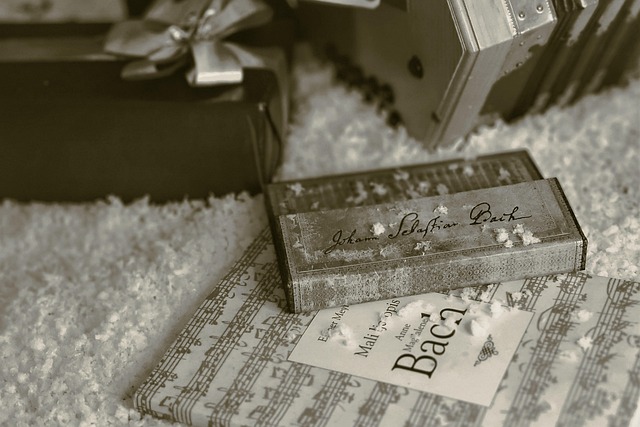
DON’T STOP—PLEASE READ ON!
Many people today see the name “Bach” and turn off the switch to their hearing. This is very unfortunate for them. What most of us do not know is what a great influence J. S. Bach has had on music down through the years.
It is unfortunate that most people have not taken the time to sit down and read the words to some of Bach’s Chorals. The words and melodies were written by others before Bach’s time and he harmonized the chorales as we hear them. Bach was a tremendously spiritual man as the Chorales prove.
Jesus, Priceless Treasure, Source of Purest Pleasure, Truest friend to me; Ah, how long I’ve panted, And My heart hath fainted, Thirsting, Lord for thee! Thine I am, O spotless Lamb, I will suffer naught to hide thee, Naught I ask beside Thee.
Hence, all thoughts of sadness! For the Lord of gladness, Jesus, enters in: Those who love the Father, Though the storms may gather, Still have peace within; Yea, what’er we here must bear, Still in thee lies purest pleasure, Jesus, Priceless Treasure.
Then there is the chorale with words in prayer form to remind us how hard it is to hold fast to the Word of God when all around us are temptations and persecutions:
Lord, keep us steadfast in Thy Word; Curb those who fain by craft or sword Would wrest the Kingdom from Thy Son And set at naught all He hath done.
Lord Jesus Christ, Thy power make known, For Thou art Lord of lords alone; Defend Thy holy church, that we May sing Thy praise triumphantly.
There is a beautiful chorale that could be used at funerals but unfortunately no one would know it:
Hark! a voice saith, All are mortal; Yea, all flesh must fade as grass; Only through death‘s gloomy portal To a better life ye pass. And this body formed of clay Here must languish and decay Ere it rise in glorious might, Fit to dwell with saints in light.
O Jerusalem, how clearly Dost thou shine, thou city fair! Lo! I hear the tones more nearly. Ever sweetly sounding there! O what peace and joy hast thou! Lo, the sun is rising now, And the breaking day I see, That shall never end for me!
What a beautiful picture of eternity for the believer! Can you imagine the whole congregation singing this together? Unfortunately, we don’t know what the tune sounds like.
Bach harmonized so may chorales that it would probably be impossible to know them all; and some are better than others. Then, too, people would like some better than others.
Today, many of us listen to music for the “beat” and sometimes we like the tune, but fail to realize how important the words are.
One of Bach’s students wrote, “As concerns the playing of chorales, I was instructed by my teacher, not to play the chorales merely off-hand but according to the sense of the words” (J. G. Ziegler, 1747). Bach’s son, C. P. E. Bach wrote (1753), “What comprises a good performance? The ability through singing or playing to make the (listening) ear conscious of the true content and affect of a composition.” When Bach wrote his music, he used the sounds and rhythms to emphasize the words.
Now, the point of all this is not to bore anyone, but to help you see that when church organists use the Bach chorales, and arrangements on them, you will see that usually they have been chosen to fit into the service. Most ministers today give the organists the service information well in advance. Many hours are then spent choosing music to fit the various parts of the service and then in practicing.
When “songs” are used that the organists believe are unfamiliar to the congregation, he or she should try to print the words for your edification. Sometimes there are no words and then the music can be used as back-ground for your own meditation and prayer in preparation for the service. Or, in case of the offertory, meditating on what has been heard in the sermon.
PLEASE, don’t be “switched-off” by Bach!
Mrs. Julien is the wife of Jerome M. Julien, pastor of the First Christian Reformed Church at Sheldon, Iowa.