


In the modern religious landscape, Eastern Orthodoxy presents itself as the pristine alternative for evangelicals weary of the perceived shallowness of contemporary worship. Its appeal lies in a claim of “unbroken continuity”—the idea that the incense-filled, icon-laden liturgy of today is the exact same worship practiced by the Apostles and the early martyrs. Yet, when we move past the aesthetic allure and delve into the intellectual and historical record, we find that the “continuity” claim rests on a foundation of sand. The early church was not pre-iconic; it was aniconic.1 To understand the thinking behind this stance is to rediscover a church that viewed the visual representation of the divine not as a window to heaven, but as a shutter closing out the light of the Word.
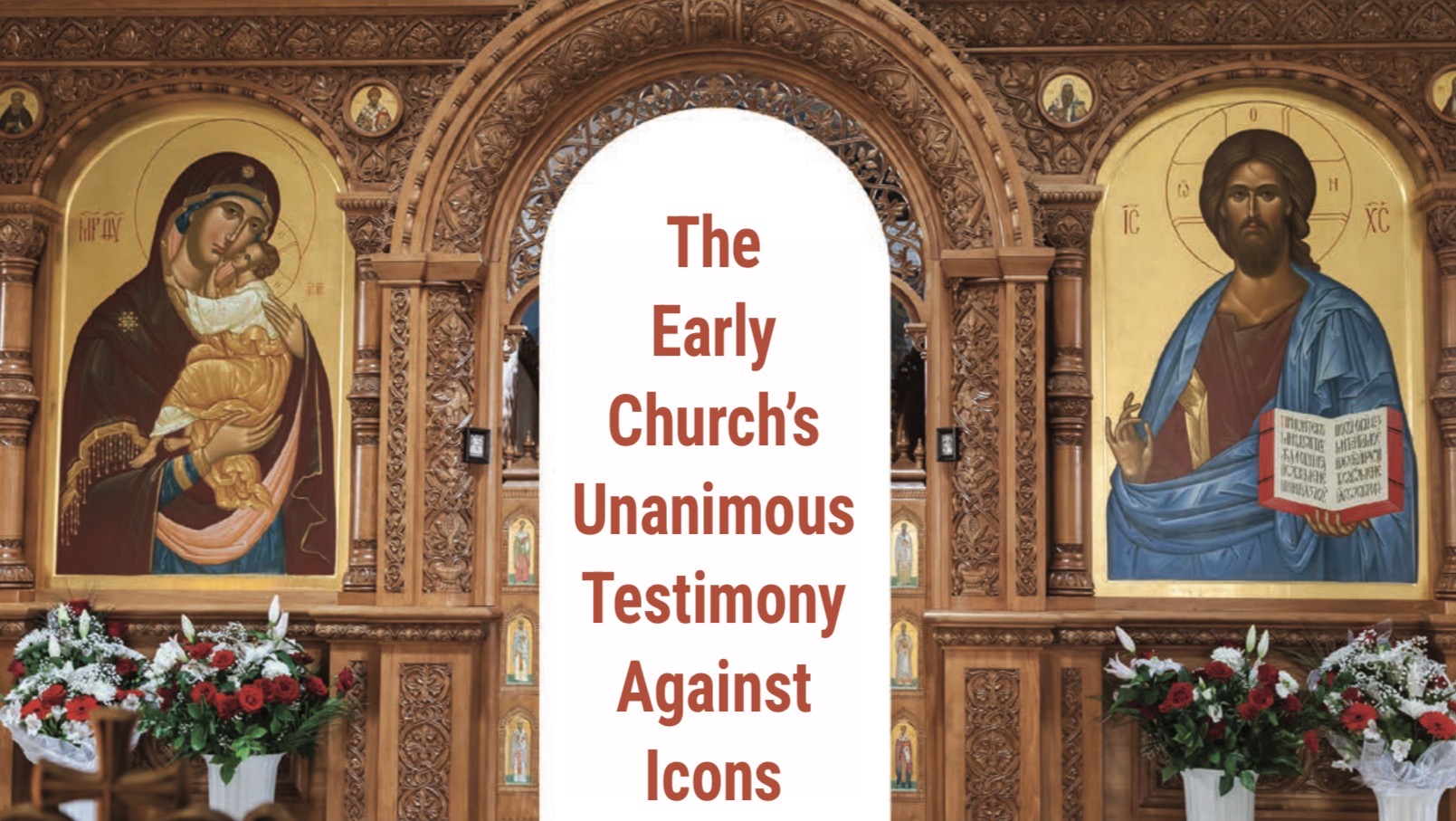
What Is an Icon?
We must first clear the semantic fog. Eastern Orthodox Apologists (EOAs) conflate any instance of Christian art with the practice of iconography. However, an icon in the liturgical sense is not merely a painting; it is a sacred image intended for veneration (proskynesis) and used as a medium for divine encounter.
The early church distinguished between art (decorative or historical) and idols (images used in worship). While archaeologists have found murals in the Dura-Europos house church (ca. 235) or the Roman catacombs, there is no record of any Christian before AD 500 bowing before, kissing, or offering incense to these images. The early Christians were aniconic—they avoided images in worship—but they were not necessarily artless. They maintained a strict line: the worship of God must be mediated through the Spirit and the Word, not through the “sensible” (physical) representations of the material world.
The Jewish Background and
the Second Commandment
The primitive church did not invent its opposition to images in a vacuum; it inherited a fierce, “Second Commandment” hermeneutic from Second Temple Judaism. For the first-century Jew, the prohibition against graven images (and “any likeness of anything” in worship) was a defining boundary of their identity against the image-mad Greco-Roman world.
History records that when Pontius Pilate attempted to bring Roman standards bearing the emperor’s image into Jerusalem, the Jewish populace staged a non-violent protest, baring their necks to Roman swords rather than permit images in the Holy City. This was the environment that birthed the Apostles.
The “Protestant” Polemic of the Church Fathers
When we turn to the writings of the Fathers, their language sounds like that of the later Reformers. They did not see images as “books for the illiterate” (a later sixth-century justification); rather, they saw them as a return to the darkness of paganism.
Clement of Alexandria (ca. 150–215): A philosopher-theologian, Clement argued that the Law was designed to lead us away from the “sensible” to the “intellectual.” He stated flatly, “Works of art cannot then be sacred and divine.”2
Tertullian (ca. 155–240): The fiery North African was so rigorous that he questioned whether a Christian could even be an artist. He argued that the Second Commandment “interdicted” all similitudes.3
Marcus Minucius Felix (d. ca. 250): The distinguished Roman lawyer and early Latin Christian apologist had his pagan interrogator, the fictional Caecilius Natalis, ask of Christians, “Why have they no altars, no temples, no acknowledged images?”4 Arnobius noted that his pagan prosecutor was “in the habit of fastening upon us a very serious charge of impiety because…[we] do not set up statues and images of any god.…”5 Romans frequently considered the lack of religious images among Christians as prima facie evidence of atheism. These apologists were at pains to explain that it was not so.6
Origen (ca. 184–254): In his sophisticated defense of Christianity against the pagan critic Celsus, Origen rejected the idea that images were symbols of the divine. He argued that Christians “cannot allow in the worship of the Divine Being altars, or temples, or images.”7
Lactantius (ca. 250–325): Often called the “Christian Cicero,” Lactantius provided perhaps the most devastating summary: “It is undoubted that there is no religion wherever there is an image.”8
Arnobius of Sicca (255–330): The fourth-century North African rhetorician turned vigorous Christian apologist wrote, “What greater wrong, disgrace, hardship, can be inflicted than to acknowledge one god, and yet make supplication to something else—to hope for help from a deity, and pray to an image without feeling?…There is nothing divine in images.”9
Eusebius of Caesarea (ca. AD 263–339):“The Father of Church History” and scholarly bishop received a letter from the emperor’s sister, Constantia, asking him for a picture of Christ. He politely rebukes her, saying, “Did the reading escape you where God commanded not to make any likeness of anything in heaven above or on the earth beneath?”10
Epiphanius of Salamis (ca. 310–403): The fourth-century bishop and canonized “saint” in Eastern Orthodoxy and Roman Catholicism tore down a church curtain bearing an image of Christ when he found one travelling in Palestine. He wrote that he was “loath that an image of a man should be hung up in Christ’s church contrary to the teaching of the Scriptures.”11
The Council of Elvira: Canon 36
If there is a historical fact that destroys the claim of early church iconography, it is Canon 36 of the Council of Elvira (ca. 306). This council of Western bishops met just before the rise of Constantine and issued a prophylactic decree against icons arising in the church. The canon states: “It is decided that there should be no pictures in the church, lest what is worshipped and adored be painted on the walls.” This was not a regional quirk; it was a formalization of the thinking that had dominated the church for three centuries.
The Gnostic Deviation: The First Icons
One of the more revealing details in this debate is that the earliest explicit literary reference to Christians possessing images of Christ comes not from the catholic mainstream, but from a second-century Gnostic sect. According to Irenaeus of Lyons in Against Heresies (1.25.6), the Carpocratians claimed to have a portrait of Christ allegedly commissioned by Pontius Pilate. They reportedly displayed this image alongside portraits of philosophers such as Pythagoras and Plato, crowned them, and treated them “after the same manner of the Gentiles.”12 While this does not prove that orthodox Christians rejected all visual representation, it does show that one of the earliest documented cases of Christ-images appears in a heterodox setting rather than within the emerging catholic tradition.
When the early Church Fathers like Irenaeus (ca. 130–202) and Hippolytus (ca. 170–235) wrote about this, they did not say, “The Gnostics are doing it wrong; here is the correctway to use icons.” Rather, they cited the very act of using images of Christ as evidence of the Gnostics’ pagan and heretical nature. The thinking of the early church was clear: icons were a hallmark of the “other,” not the “faithful.”
Deconstructing the Luke Myth
To bypass this wall of historical condemnation, later icon-venerators fabricated the legend that Luke was the first iconographer. This myth, which claims Luke painted the Virgin Mary, did not emerge until the eighth and ninth centuries—appearing during the height of the Iconoclast controversy to provide apostolic cover for a recent innovation.13
The early church knew nothing of this legend. Augustine of Hippo (354–430), one of the most brilliant minds in church history, explicitly stated in De Trinitate that “neither do we know the countenance of the Virgin Mary.”14 If the Apostles had passed down holy icons, the most learned bishop in the West would have been aware of them.
Conclusion: The Triumph
of the Word
The Achilles’ heel of the Eastern Orthodox apologetics is, ironically, the claim it uses to sell itself to evangelicals today: its insistence on unbroken continuity with the early church. If the church today requires the use of icons, but the church of the first 500 years condemned them, then the continuity is historical fiction. The early church’s testimony was unanimously against icons. As Epiphanius insisted, icons are “contrary to our religion.” So, contrary to the claims of Eastern Orthodox apologists trying to woo our church members, returning to the early church is not to embrace the icon, but to embrace the simplicity of the Word.
1. John B. Carpenter, “The Early Church on the Aniconic Spectrum,” The Westminster Theological Journal, 83, No. 1, May, 2021.
2. Clement of Alexandria, Stromata, 2.18, 5.5,7.5 (ANF 2:530).
3. Tertullian, Idol, 5 (http://www.newadvent.org/fathers/0302.htm).
4. Minucius Felix, Octavius, Ch. 10, https://www.newadvent.org/fathers/0410.htm. On Minucius’s imaginary dialogue, see Jensen, “Aniconism in the First Centuries of Christianity,” 409.
5. Arnobius, Against the Heathen, 6.1.
6. Paul Corby Finney, The Invisible God, 40.
7. Origen, Cels., 7.64 (http://www.newadvent.org/fathers/04167.htm.
8. Lactantius, Divine Institutes, Book II (Of the Origin of Error), 19.
9. Arnobius, Against the Heathen, 6.9, 16.
10. Eusebius, “Letter of Eusebius to Constantia,” Ante-Nicene Christianity, 24, https://ante-nicenechristianity.com/articles/letter-of-eusebius-to-constantia/.
11. Epiphanius, Letter 51, ch. 9 (http://www.newadvent.org/fathers/3001051.htm).
12. Irenaeus, Haer, 1:25.6 (http://www.newadvent.org/fathers/0103125.htm.
13. Bissera V. Pentcheva, Icons and Power: The Mother of God in Byzantium (University Park: Pennsylvania State University, 2006), 124.
14. Augustine, De Trinitate, 8:5 (NPNF, 3).
………… Rev. Dr. John B. Carpenter is pastor of Covenant Reformed Baptist Church, in Danville, VA, and the author of Seven Pillars of a Biblical Church (Wipf and Stock, 2022) and the Covenant Caswell substack.