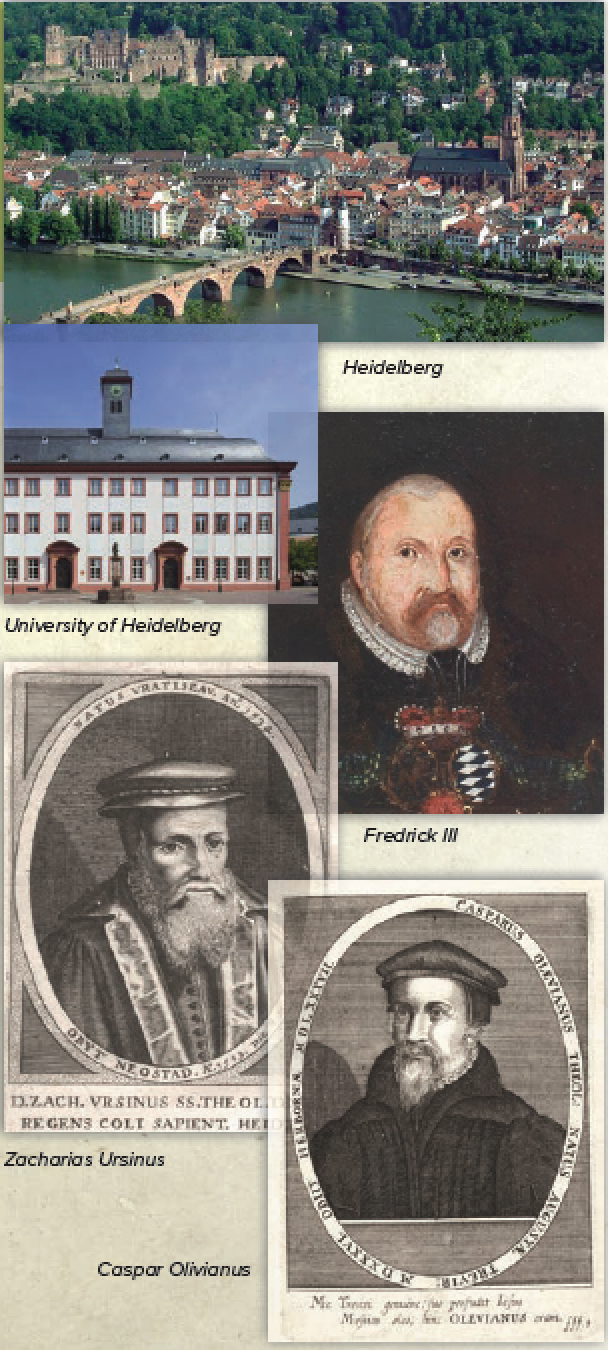
The Heidelberg Catechism was so named after the city of its birth. From 1231–1720 it was the capital of the Palatinate, one of Germany’s finest provinces, located on both sides of the upper Rhine. The University of Heidelberg, founded in 1386, was the center of varied Protestant theological activity, Lutheran, Zwinglian, Calvinistic. It was the public scandal of a Lutheran and Zwinglian fighting with one another at the altar for the communion cup, that was the immediate occasion for the writing of the HEIDELBERG CATECHISM.
Fredrick III, the Elector of Palatinate, had as his chief goals (a) carrying forward the work of the Reformation and (b) conciliating the conflicting Protestant parties.
To that end he called two young divines Zacharias Ursinus and Caspar Olivianus to Heidelberg to aid in the Reformation and prepare an evangelical catechism. The intellectual vigor and clarity of one and the spiritual warmth and unction of the other blended together in giving the world a masterpiece which was at once a guide for the religious instruction of the youth and a confession of faith for the church. In 1562 Frederick submitted the completed document to a synod of ministers and teachers assembled at Heidelberg for revision and approval. It was published the next year, 1563, with a preface in which the Elector speaks of it as “a summary instruction or catechism of our Christian religion from the word of God, to be used hereafter in churches and schools for the benefit of the rising generation.” It was later translated into other European and Asian languages, and became next to the Bible as one of the most widely used Christian publications.
Article credit: The Doctrinal Standards of the RCA booklet