


Why Bavinck?
The last few years have witnessed a revival of interest in the Dutch theologian Herman Bavinck (1854–1921). On a scholarly level, this might have been sparked by John Bolt’s English translation of Bavinck’s four-volume Reformed Dogmatics1 at the turn of the century. But the interest has quickly moved beyond the confines of academia. James Eglinton’s Bavinck: A Critical Biography2 has made Bavinck’s life and thought accessible to many.
At a recent women’s retreat, a few women shared how frequently their pastors quoted Bavinck. When I mentioned his name, young and old nodded their heads. Those who had read his writings noted how relevant his words are for today.
This relevance is probably what today’s Christians most appreciate. Like us, Bavinck lived in rapidly changing times and had to face questions and challenges scarcely entertained in previous centuries. His significance lies in the way he responded.
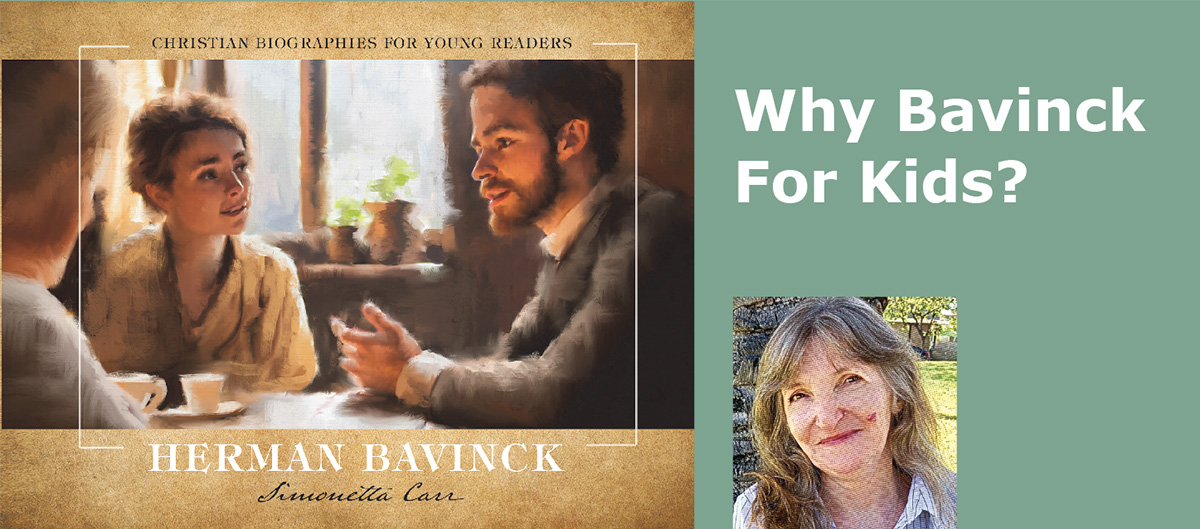
Why Bavinck for Kids?
Bavinck’s writings are weighty and require careful study. At first glance, his life may seem mundane—the life of a faithful pastor, teacher, and writer, without the adventures of other Christians in my in my biographies for young readers such as Athanasius, Martin Luther, or John Newton. And yet, it is exactly in his seemingly ordinary life that children can find answers to important questions they may face now or later.
For example, Bavinck’s decision to attend the University of Leiden—a historical school famous for questioning traditions and for reading all texts, including the Bible, in a critical manner—was surprising to some people in his Reformed circle. Why would he deliberately expose himself to such challenges? Even his best friend from high school, Henry Dosker, questioned Bavinck’s decision, since, he said, young people are “tender plants that are bent in the storm and can easily take a misshapen form.”
Reading about Bavinck’s quandary, the reasons behind his decision, the opposition and support he received, the challenges he continued to face, and the importance of his faithful church attendance will help children to think carefully about similar situations and and to better evaluate their own decisions—as well as hold a more charitable attitude toward the decisions of others.
As they survey Bavinck’s encounters with various teachers, children may learn to admire, with Bavinck, an atheist’s passion in fighting injustice—even injustice committed by nominal Christians—without concluding that Christianity should be abandoned. Rather, they can learn from Bavinck why the answer to injustice lies in a revival of true Christianity.
Children can also learn from Bavinck’s lifelong friendship with Christiaan Snouck Hurgronje, who studied with him at Leiden. The two friends continued to correspond even after Snouck converted to Islam, sharing the experiences of their lives and valuing each other’s opinions. Bavinck even sent Snouck some of his writings, in the conviction that his friend’s different point of view could help him to see different sides of each question.
These are just some of the many lessons that children can learn from Bavinck’s life and thoughts—lessons that are particularly important in our highly polarized society, where cultivating wisdom and treating others with respect and humility are becoming rare virtues.
And when they come to the end of Bavinck’s life story, children can see what a legacy a faithful Christian can leave behind, as Bavinck’s teachings were passed on and bore fruit in his own family, through his students, and by those who read his writings today.
After Bavinck’s death, his wife Johanna Adriana Bavinck-Schippers, besides negotiating to have his works translated, continued his support of women’s rights and education as women adapted to their changing roles in society. Their daughter Johanna Geziana and her family bravely took part in resistance against Hitler’s occupation of the Netherlands and genocide of Jews. This heroism cost the lives of two of the Bavinck’s grandsons, and is an example of what Bavinck taught about respecting all human beings as made in the image of God and fighting for the wellbeing of others despite personal sacrifice.
The importance of these lessons for our children was confirmed to me during a recent recording of the Kids Talk Church History podcast. While coming from different backgrounds, its young hosts agreed that what impressed them the most from their exploration of a time in church history was the ability of Christians to act in different spheres of life to the glory of God, respecting the differences and demands of each situation. I realized that it is essential for young people who are about to launch into the world to learn to live their faith in an honest and holistic manner, day by day, reflecting deeply about their choices without resorting to pre-set formulas. In this, they could not find a better example than Herman Bavinck.
1. Herman Bavinck, Reformed Dogmatics, ed. John Bolt, Baker Academics, 2011.
2. James Eglinton, Bavinck: A Critical Biography, Baker Academics, 2020.
Mrs. Simonetta Carr Award-winning author Simonetta Carr was born in Italy and has lived and worked in different cultures. A home-schooling mother for many years, she lives in San Diego with her husband Thomas and one of their eight children. Simonetta is a member at Christ United Reformed Church