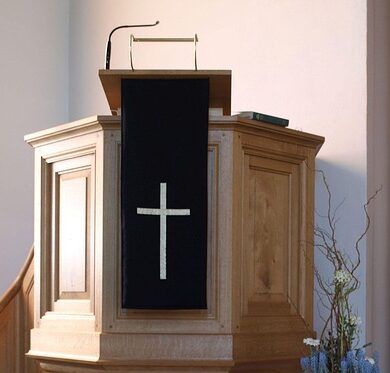
As to Preaching
During the vacancy of a former church that we attended, several ministers filled the pulpit supply over a period of two years. It would seem that variety which is the spice of life would have been the case; nevertheless, my family and I felt spiritually undernourished; so giving one reason to find a church where our spiritual needs were better met. Why this lack of spiritual nourishment? Permit me to suggest some reasons.
Today there seems to be a want of thorough exegetical preaching, the kind of preaching in which the minister searches out and mines the deep things from God’s Word. Too often the contents of the messages left the feeling that no midnight candles were burned. In some instances I felt that I as an average layman could have come up with the same insights. When I attend a recital of some noted pianist, I surely expect to hear musical scores which exceed the difficulty and complexity of “Mary Had a Little Lamb.”
Secondly , in Reformed theology we correctly make much of the balanced triad: sin, salvation, and service, and we believe there should be a balance in the presentation of these great truths of salvation. However, today there seems to be an overstress on service, with only whispers about sin. The Heidelberg Catechism properly states that believers make but a small beginning in the process of sanctification, which is another way of saying we must confront sin wherever it raises its ugly head. And no minister should be afraid to make his congregation squirm when the need is spiritually there. We seem to be enveloped in “schullerism” where one hears, sees, speaks no evil, which is a tacit denial of the doctrine of total depravity. Let our ministers become Nathans, Nehemiahs, and Jeremiahs when the need so requires.
Too, a conversational manner of detached delivery appears to be the vogue in the present manner of delivery, with the cool poise of an instructor explaining a Euclid theorem to a geometry class. Perhaps fifty years ago some ministers rapped the pulpit too often and too hard, but at least the listener knew that the pastor cared and was concerned. And at its least good, it awakened the sleeping pew occupant.
Lately, humor is being introduced to the pulpit and, too often, at the beginning of a service, as if the guest speaker were seeking to ingratiate himself with his audience. There can be a place for humor, but its use must be as sparse as my wife would use her array of spices in cooking.
Sound doctrine is a hallmark of Reformed theology, and the Apostle Paul stresses its need in the Epistle to Timothy. Yet how often are we led back to the old truths from our pulpits? Our forefathers were steeped in these doctrines, and it gave the stamina, with the indwelling of the Spirit, to stand in the evil days. Today in our present affluence and luxury we seem to think these old truths no longer necessary for us. No wonder then, that cults and attenuated forms of Christianity can make such headway in our American society and churches.
John H. Sietsema, 2016 Rosewood Ave., S. E., Grand Rapids, MI.